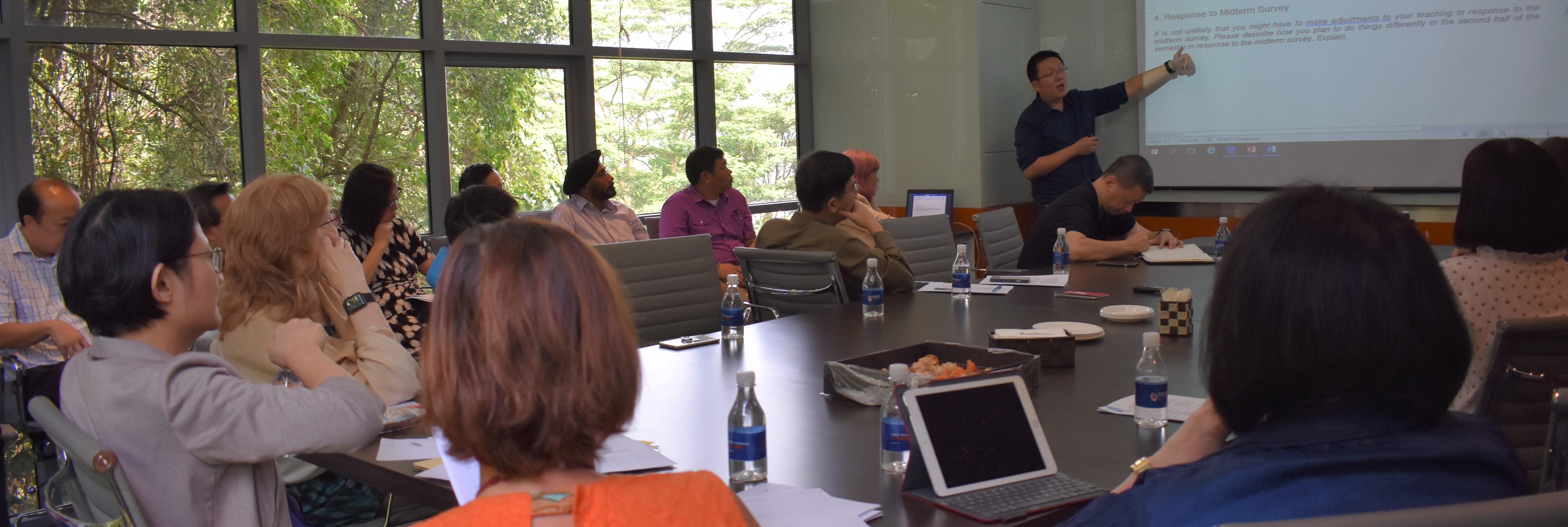
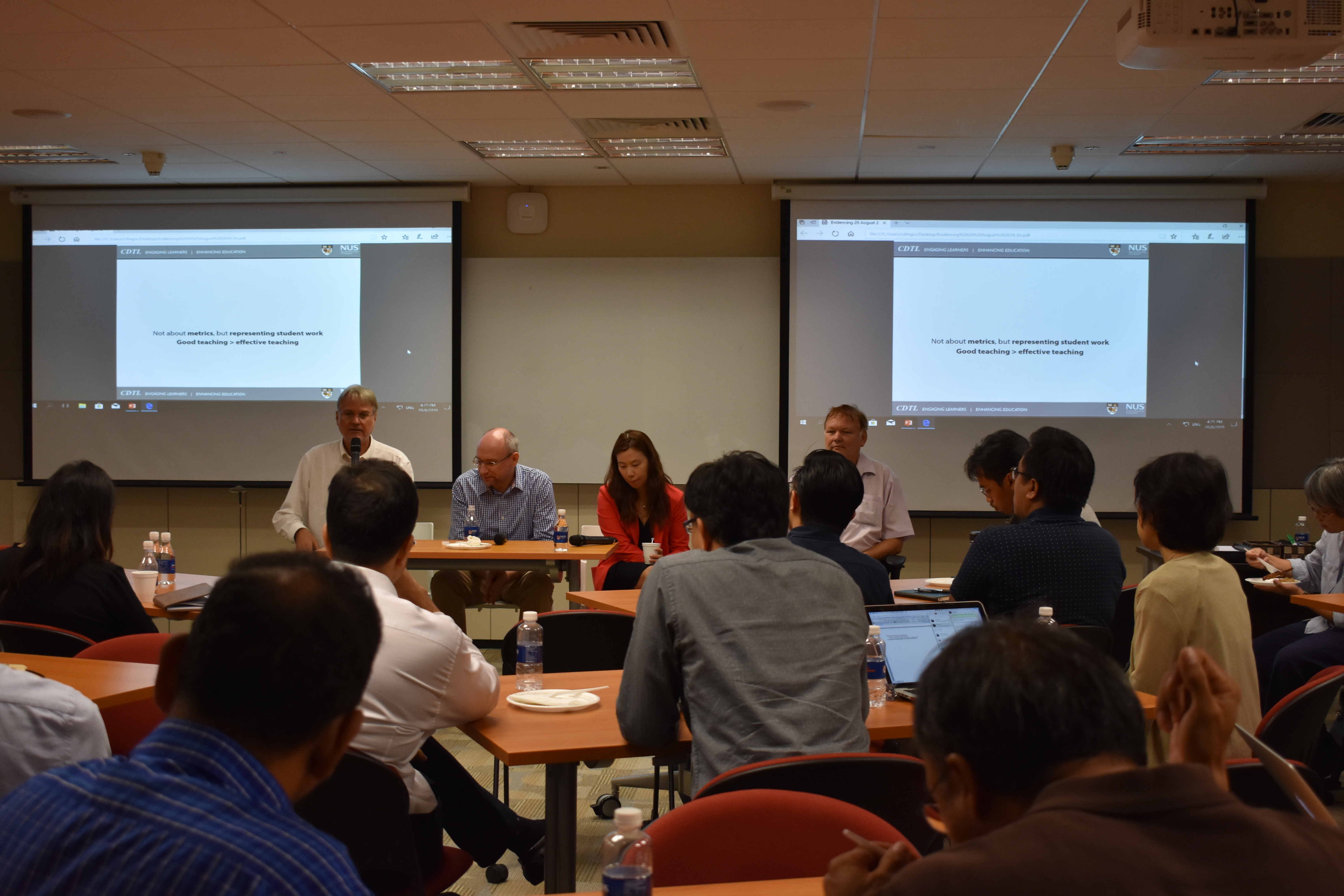
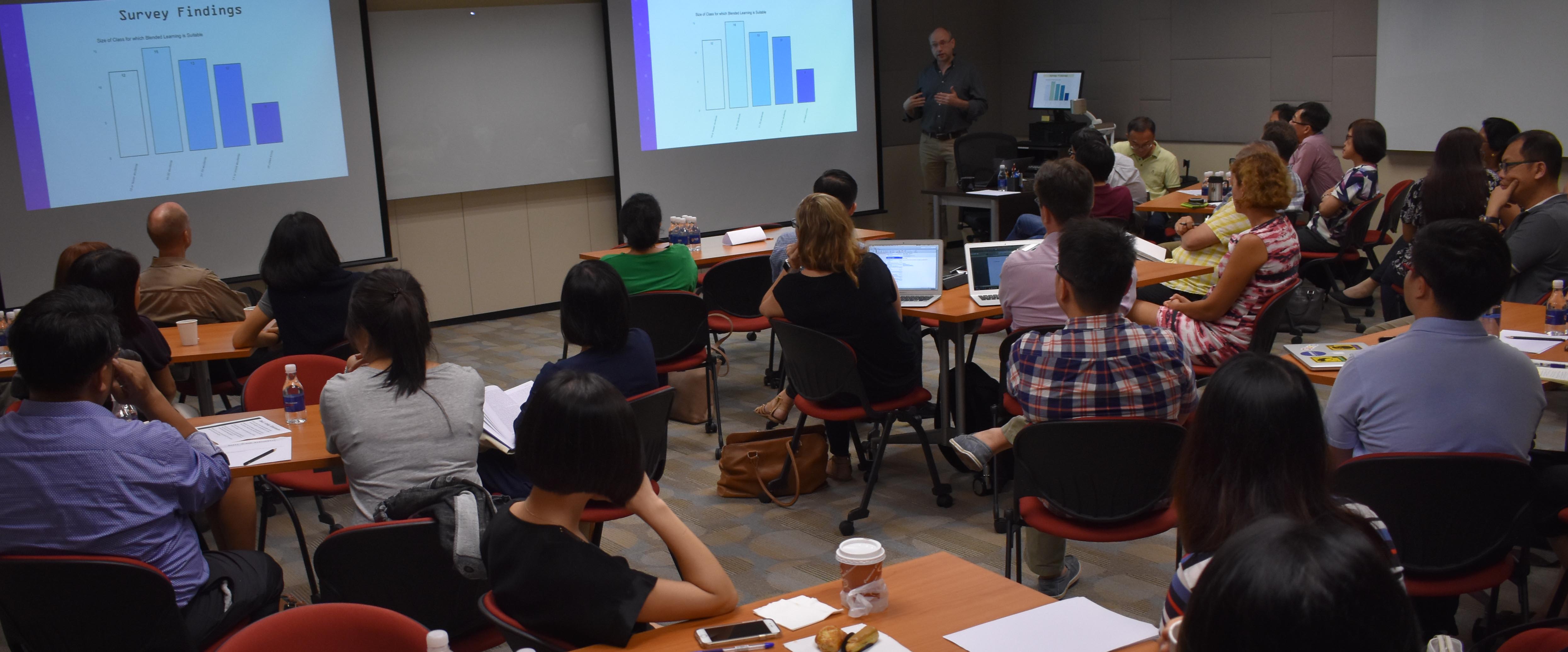
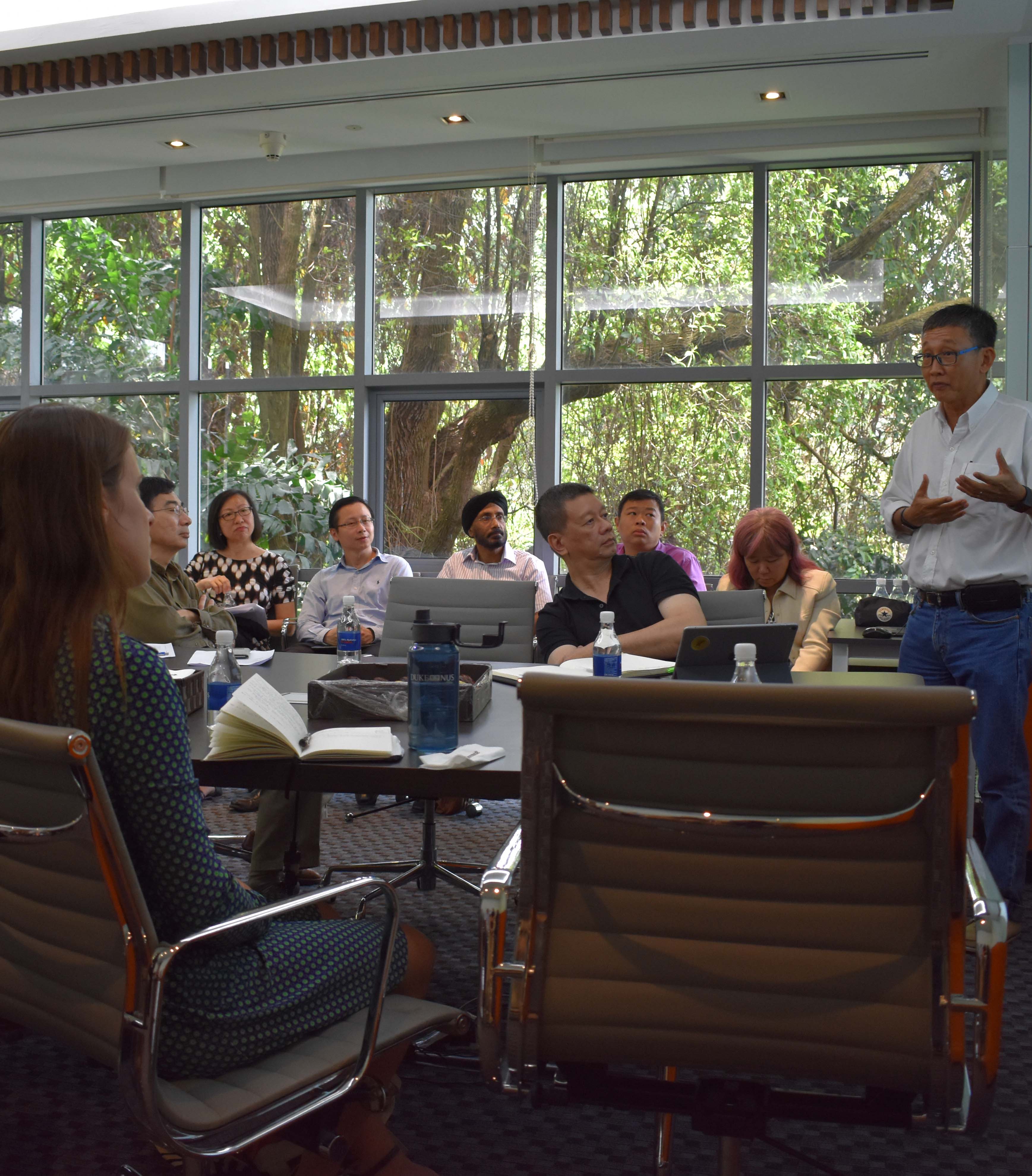
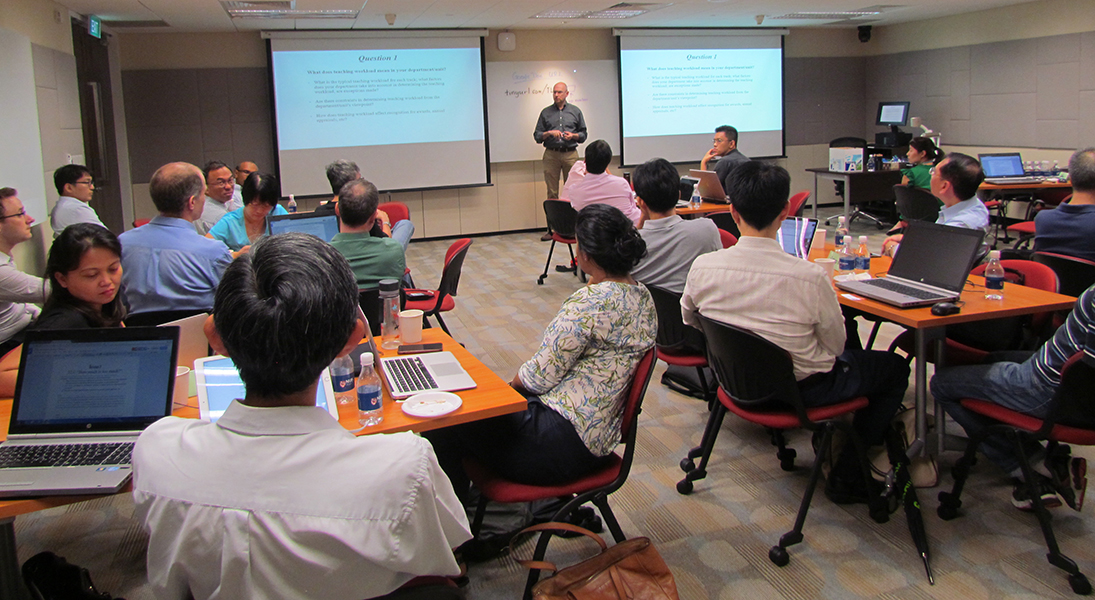
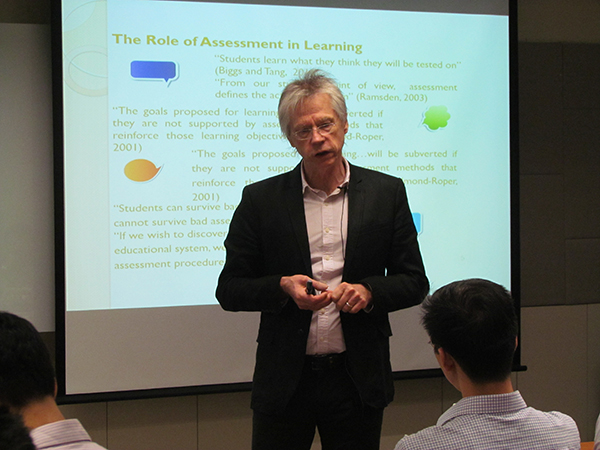
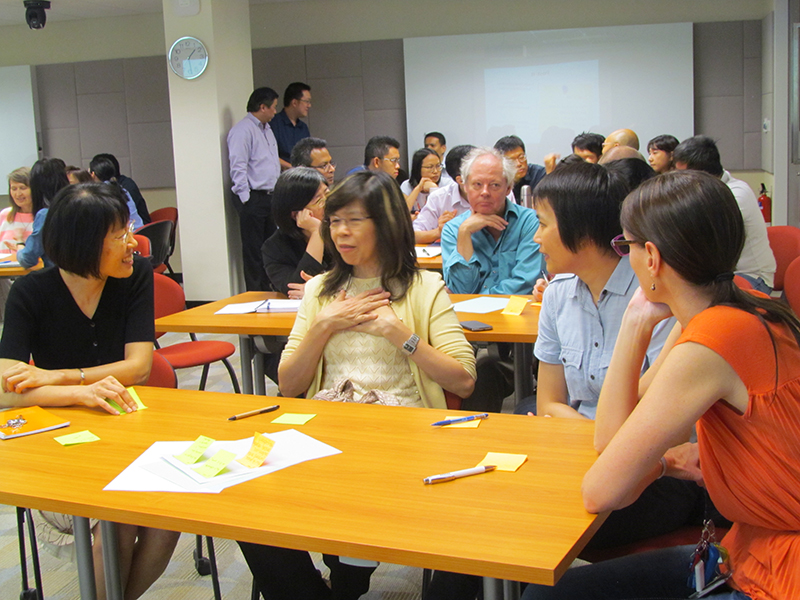
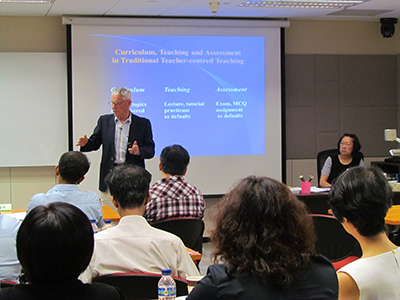
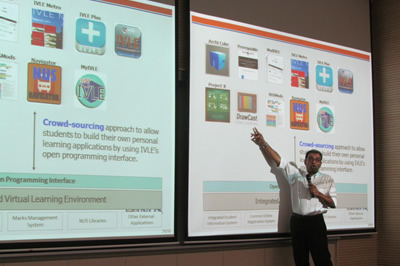
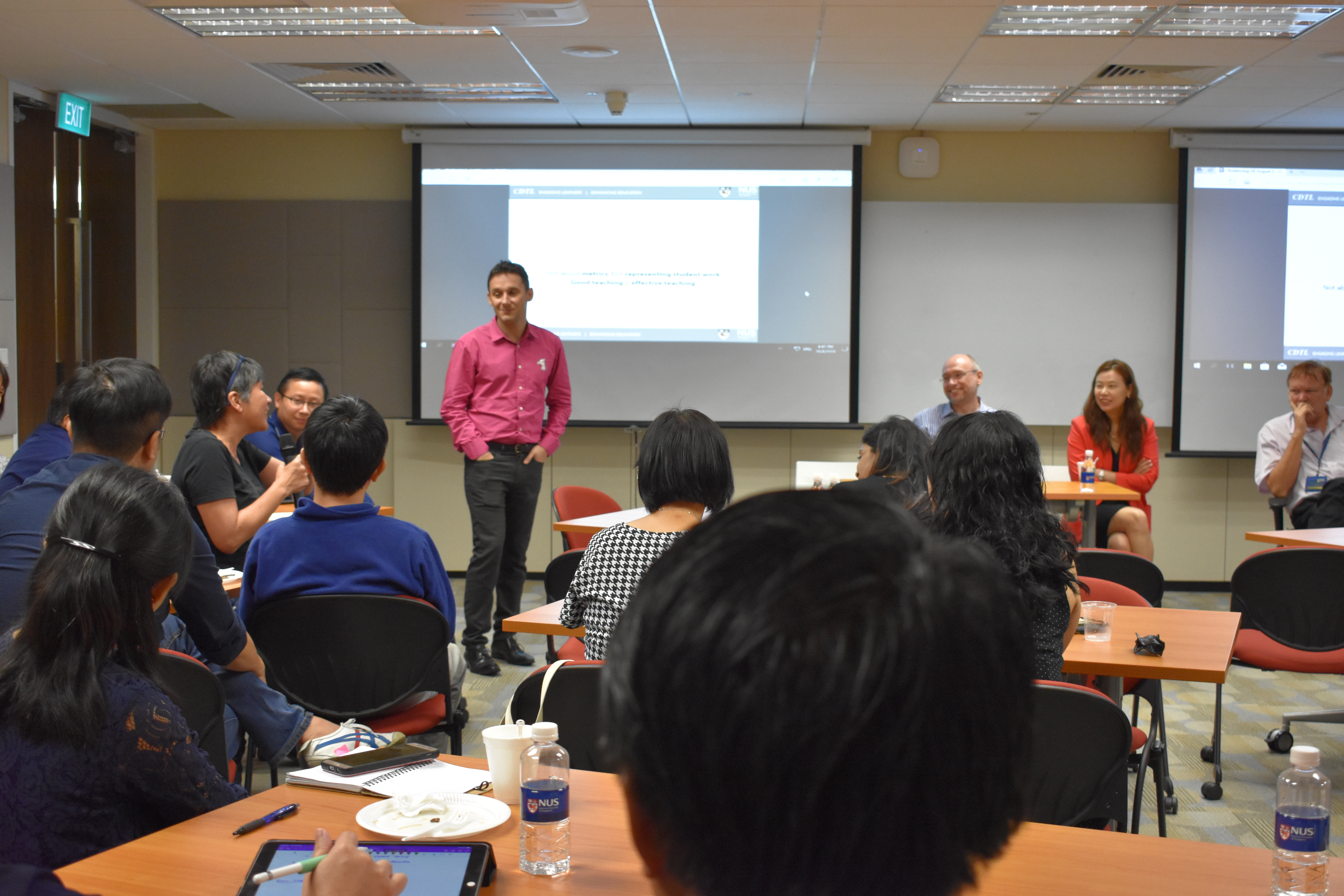
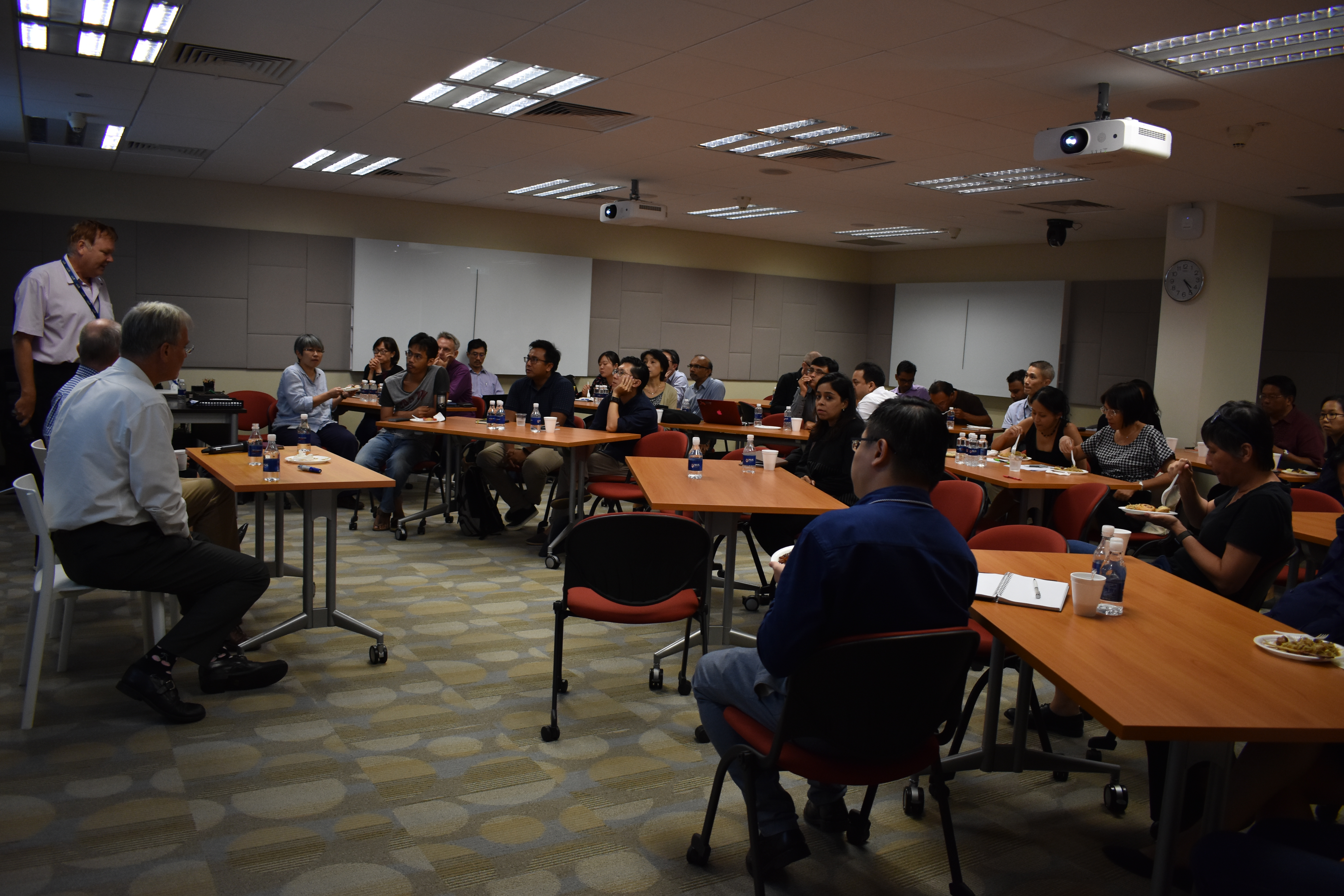
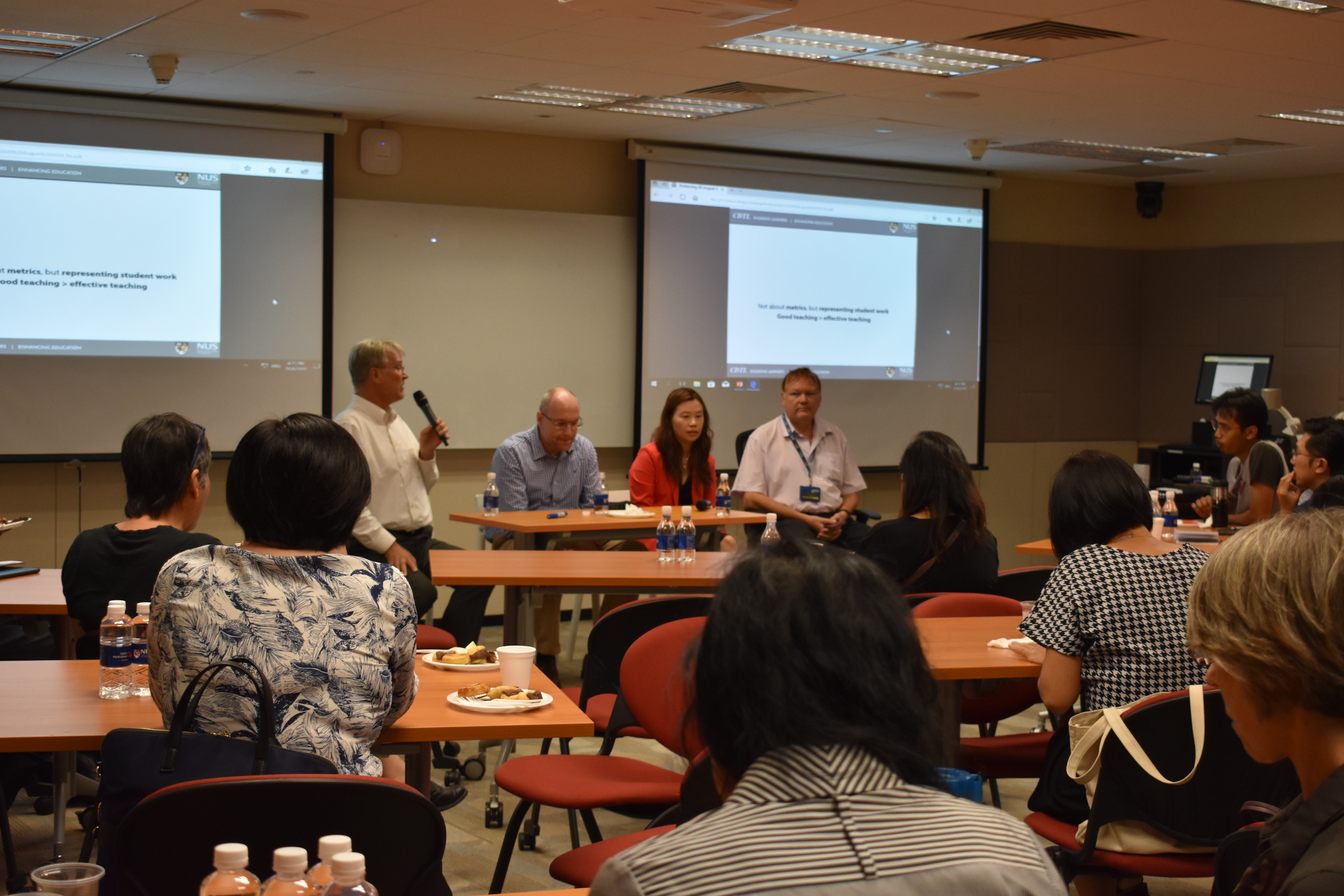
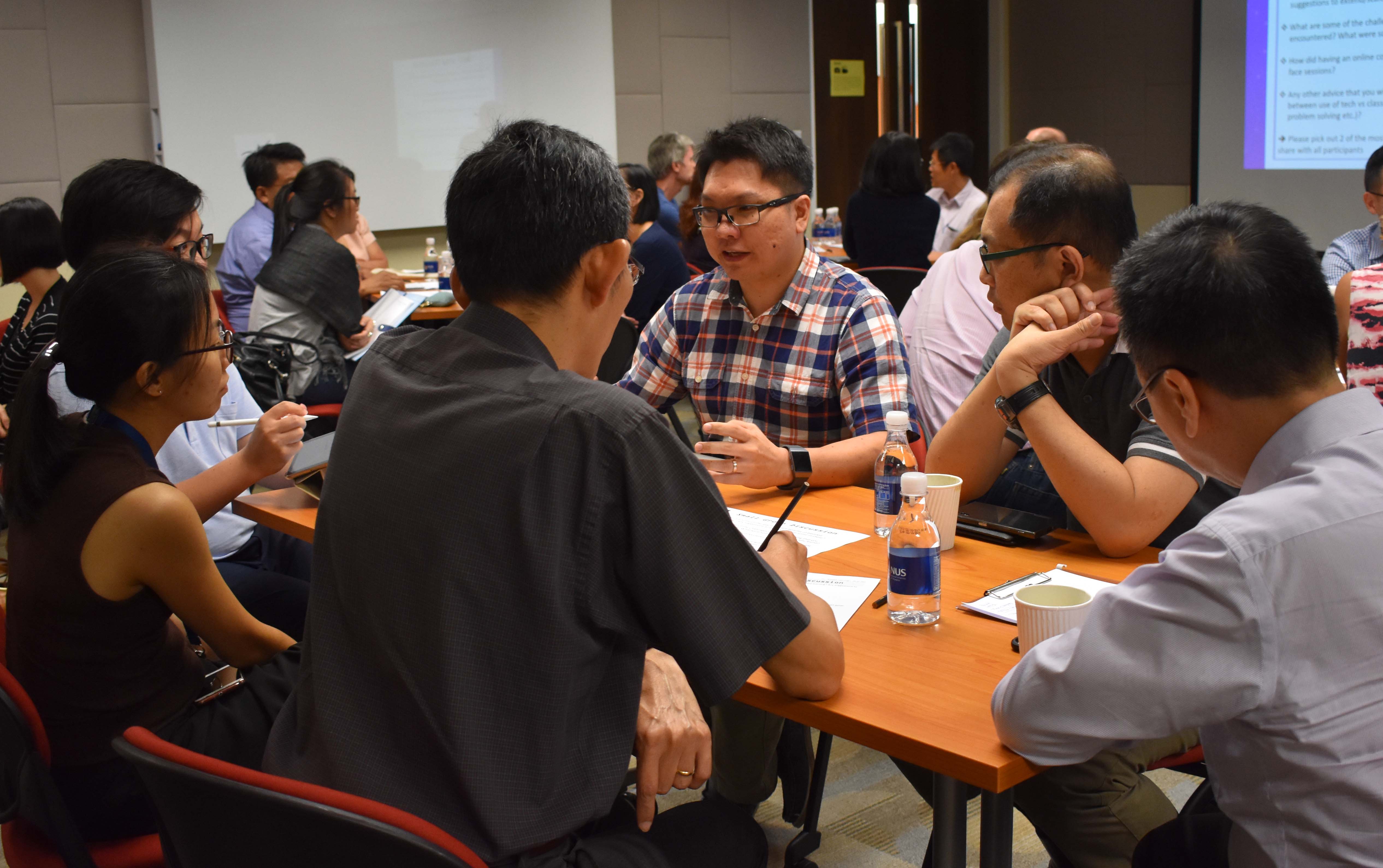
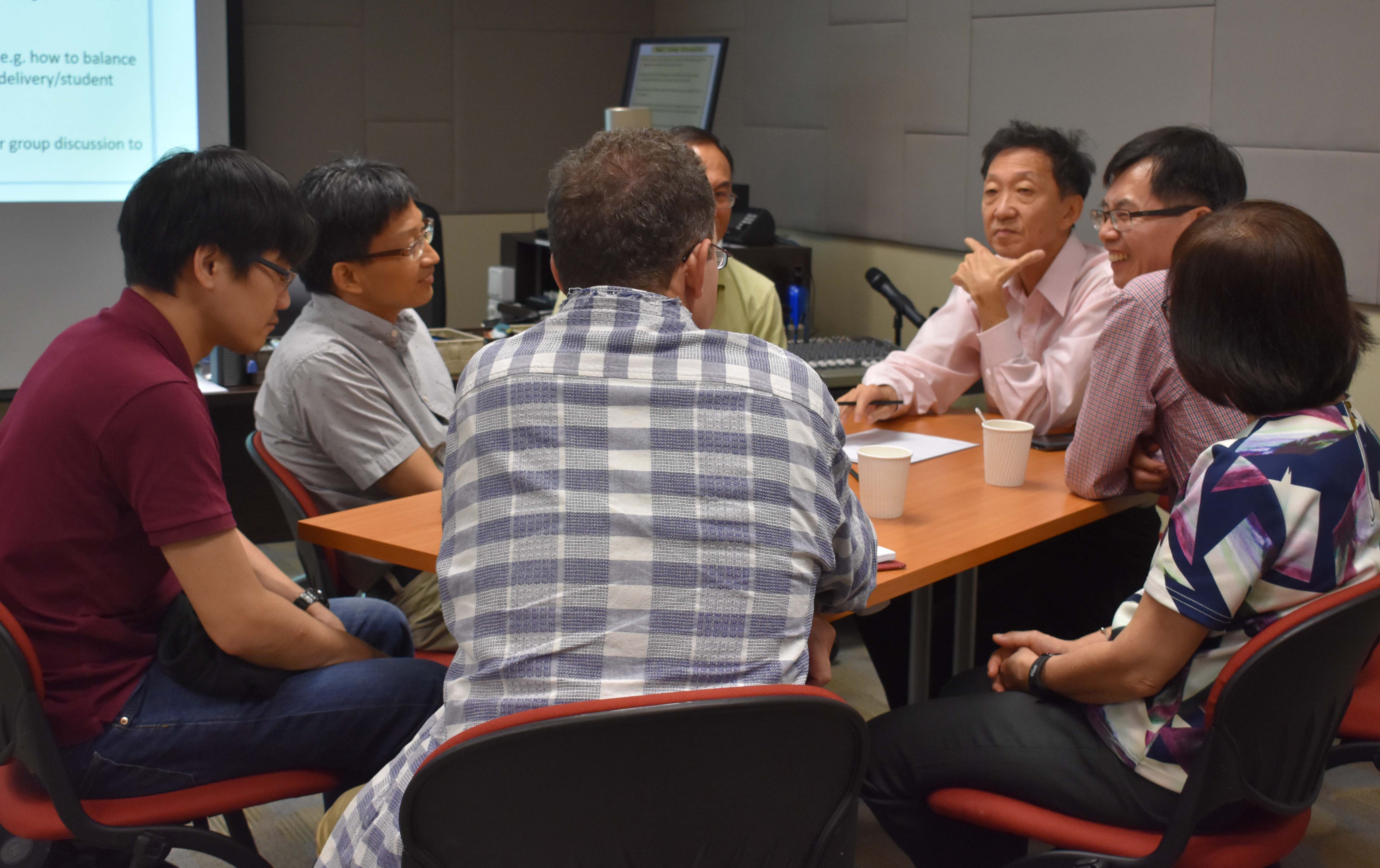
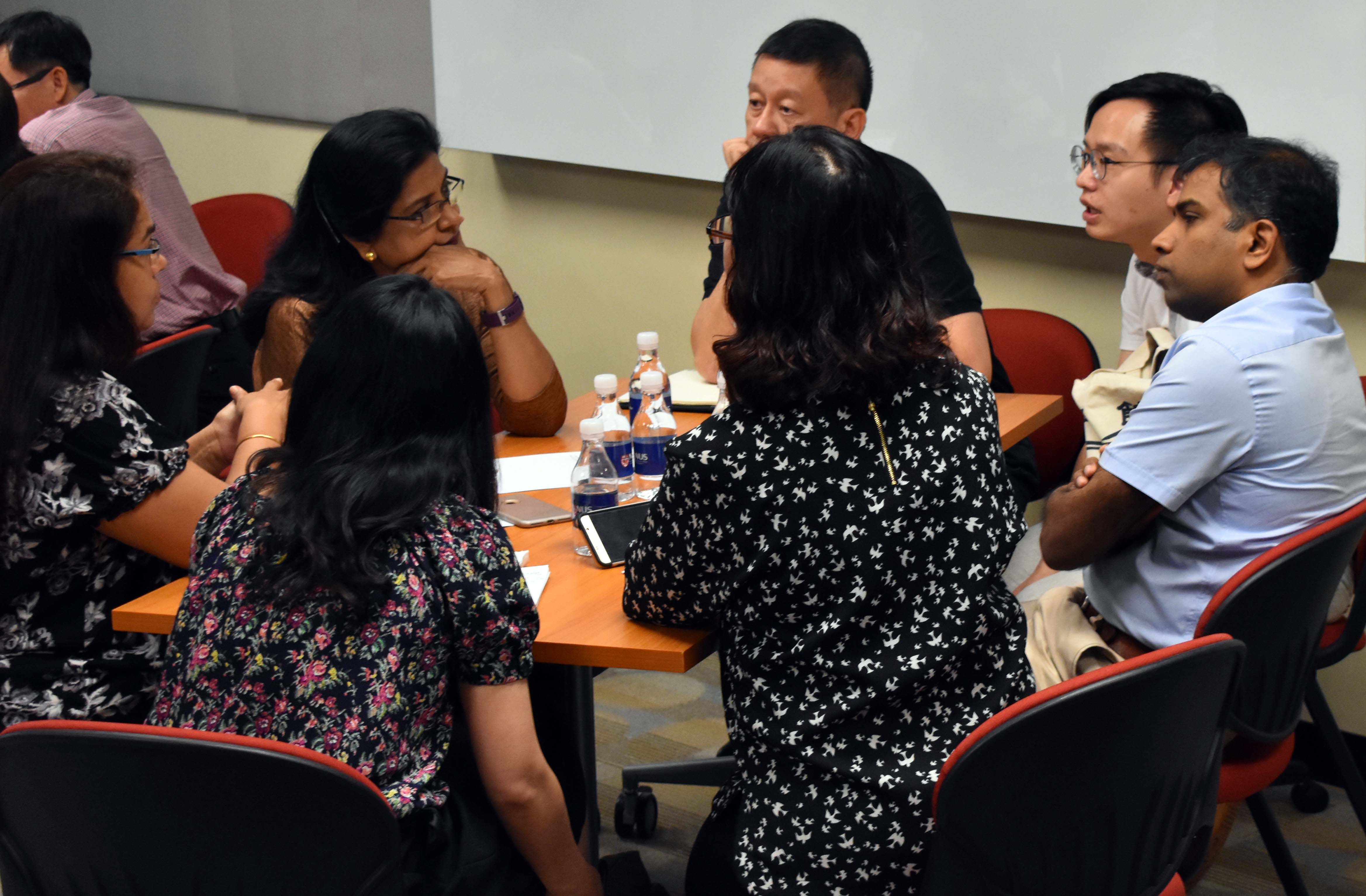
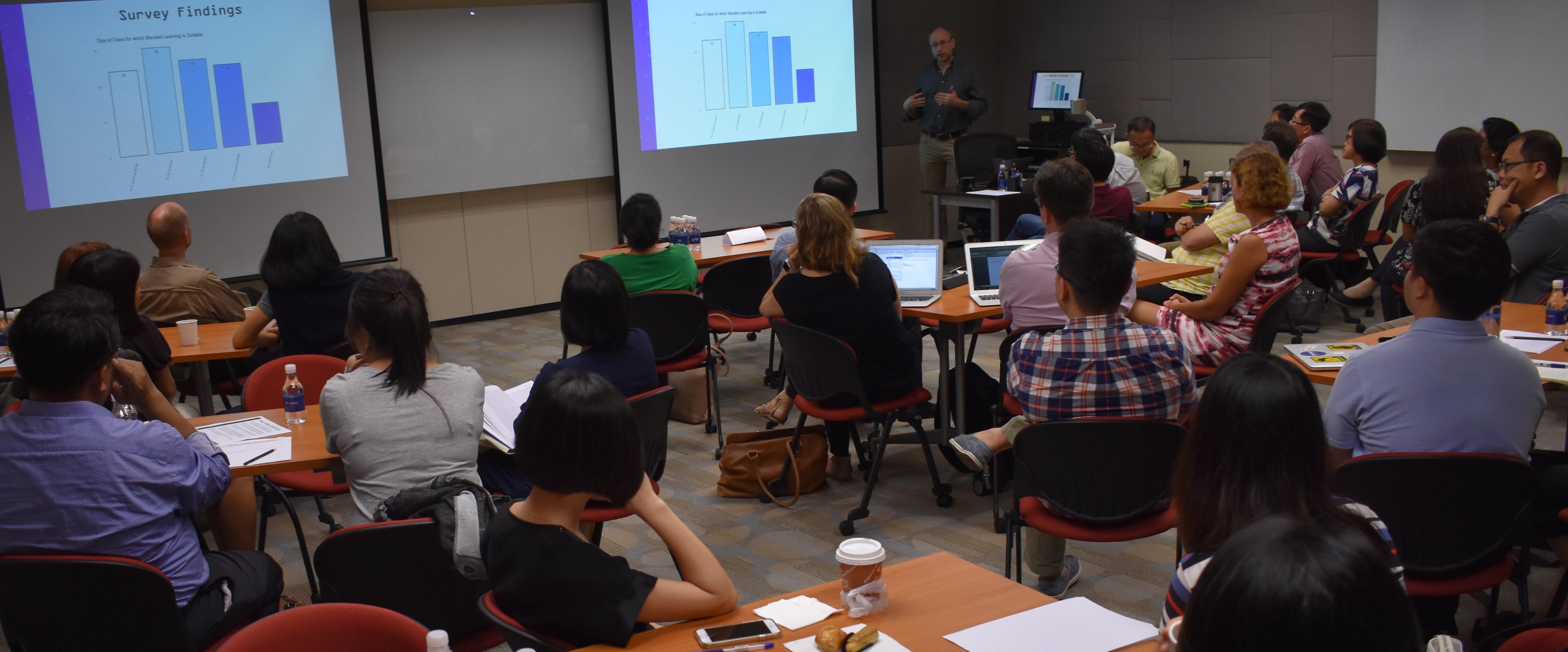
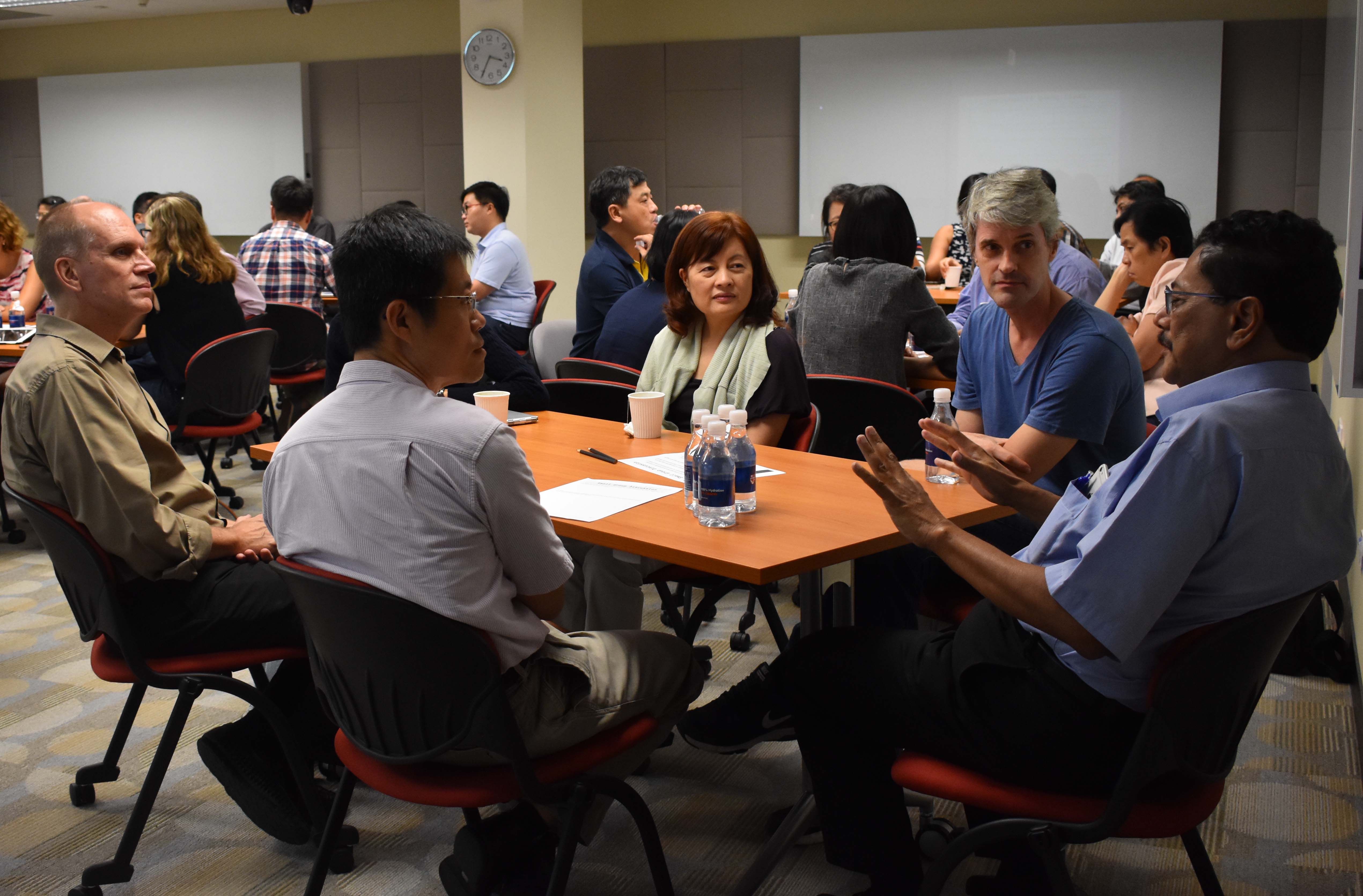
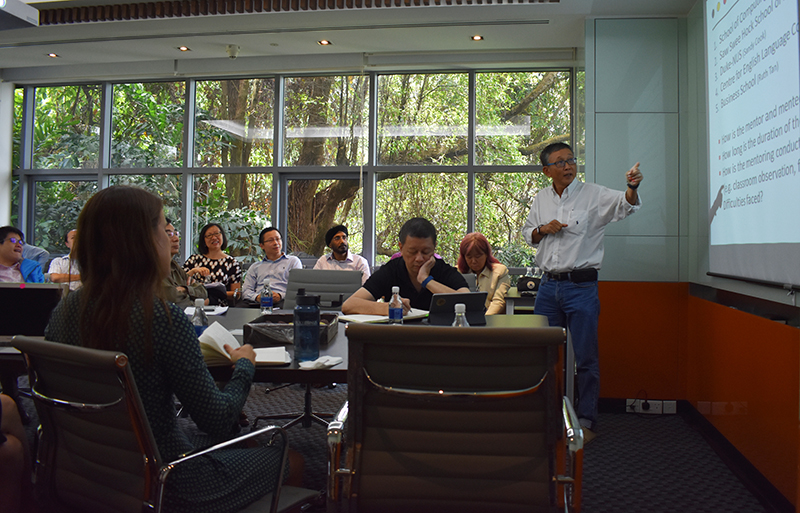
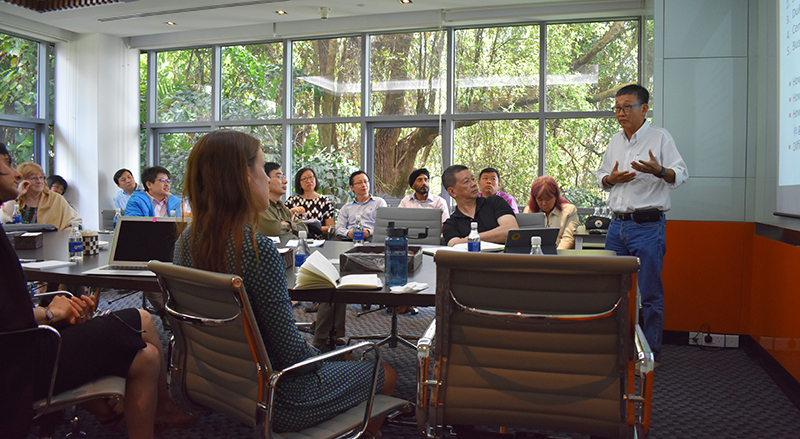
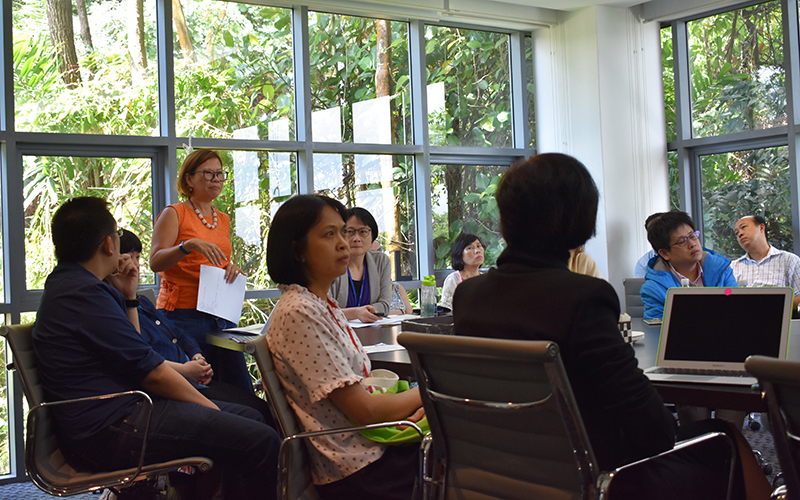
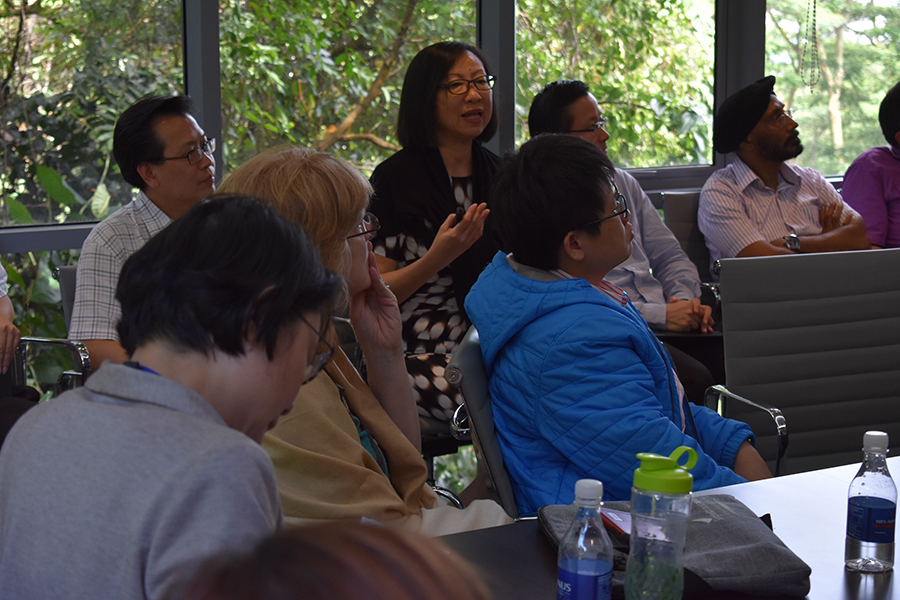
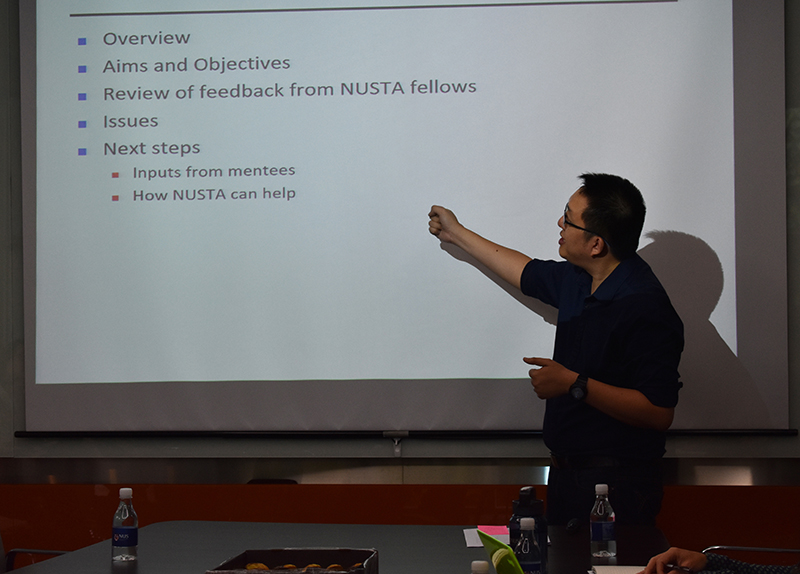
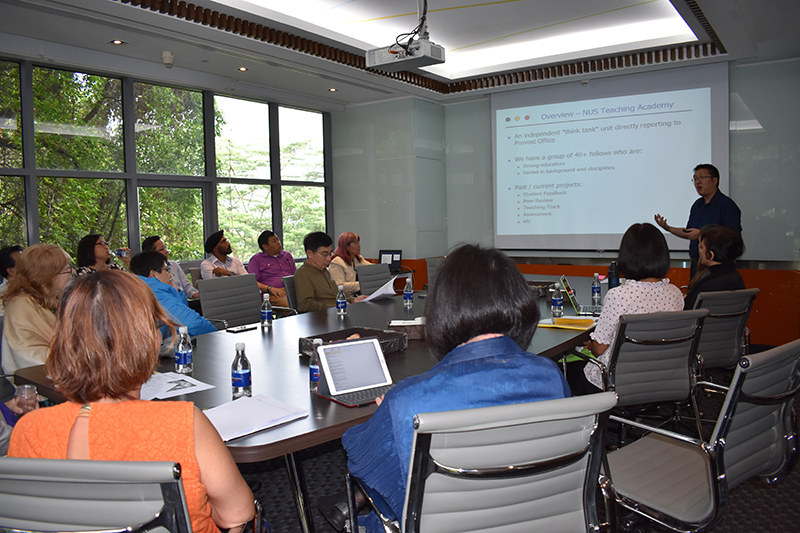
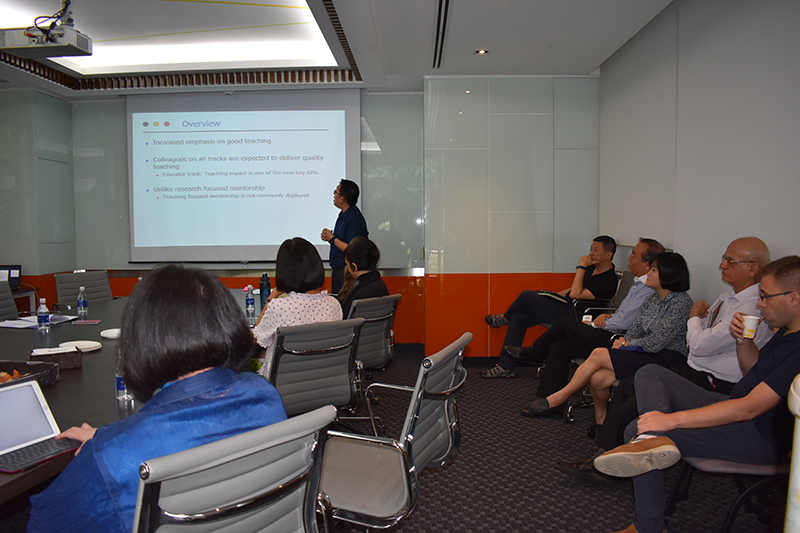
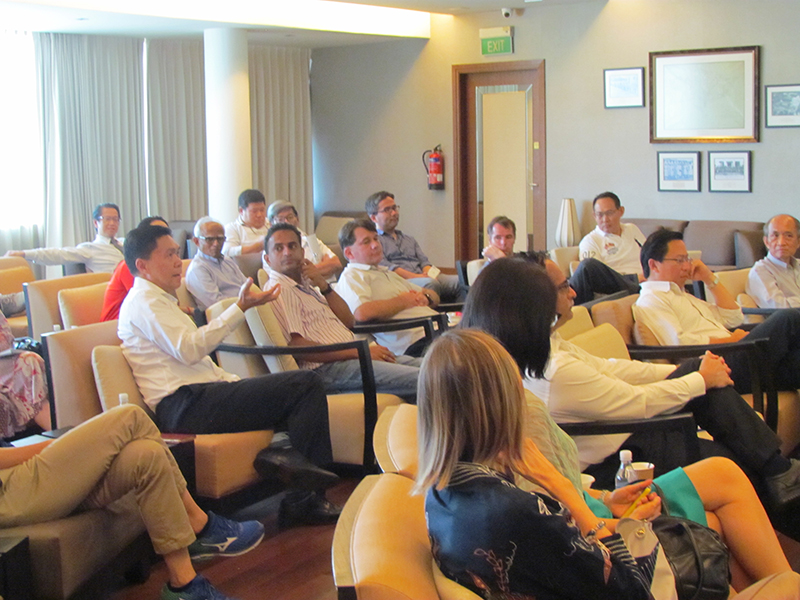
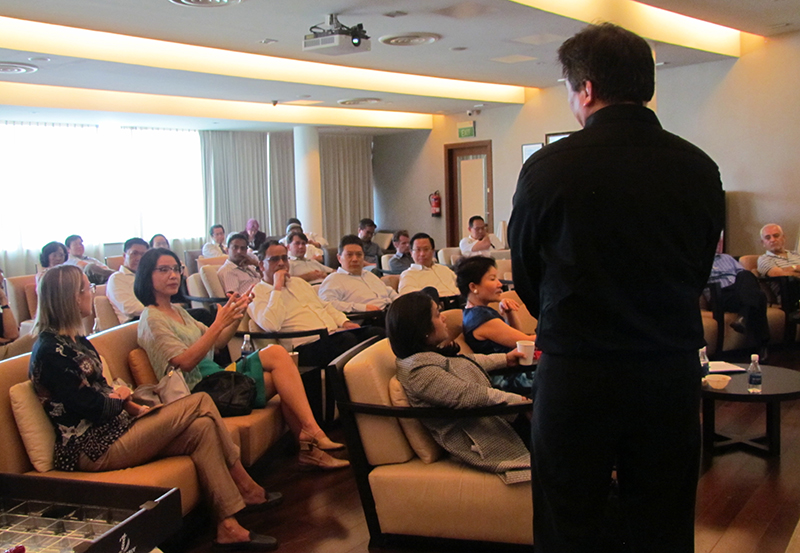
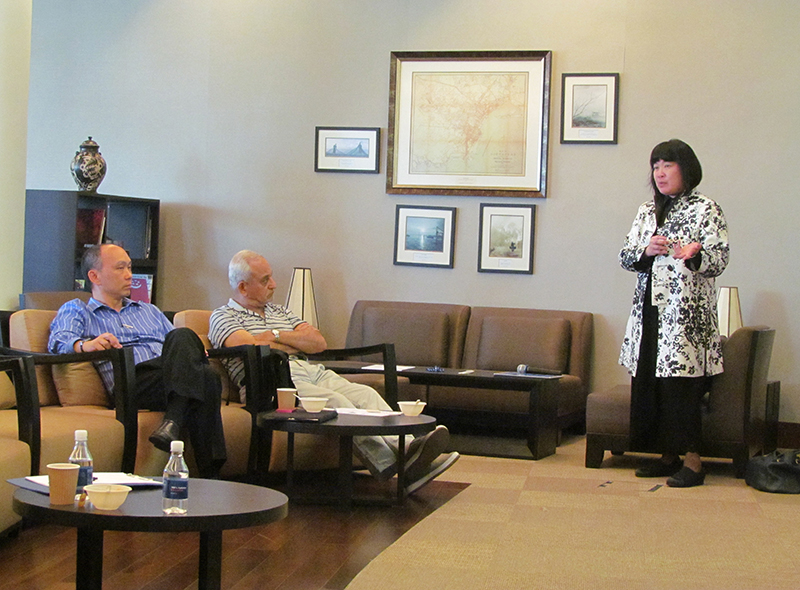
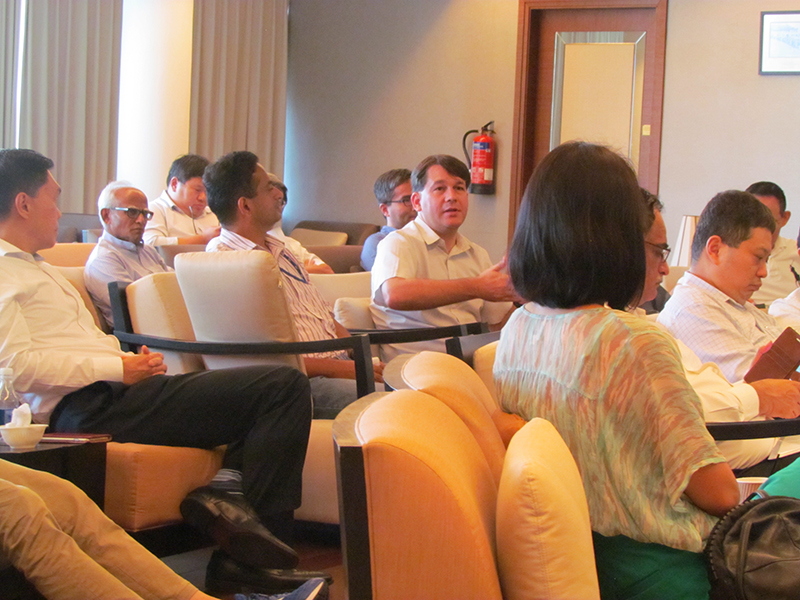
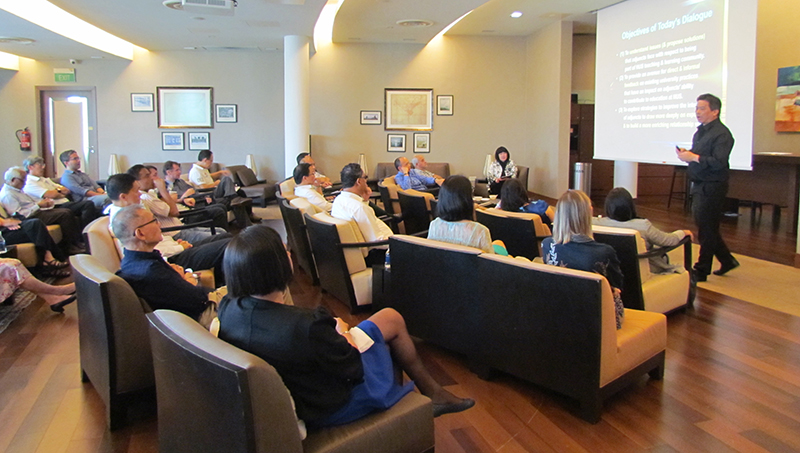
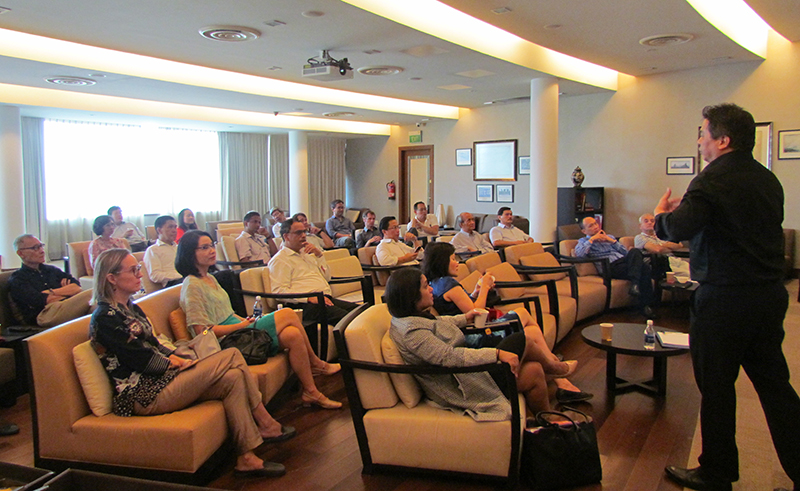
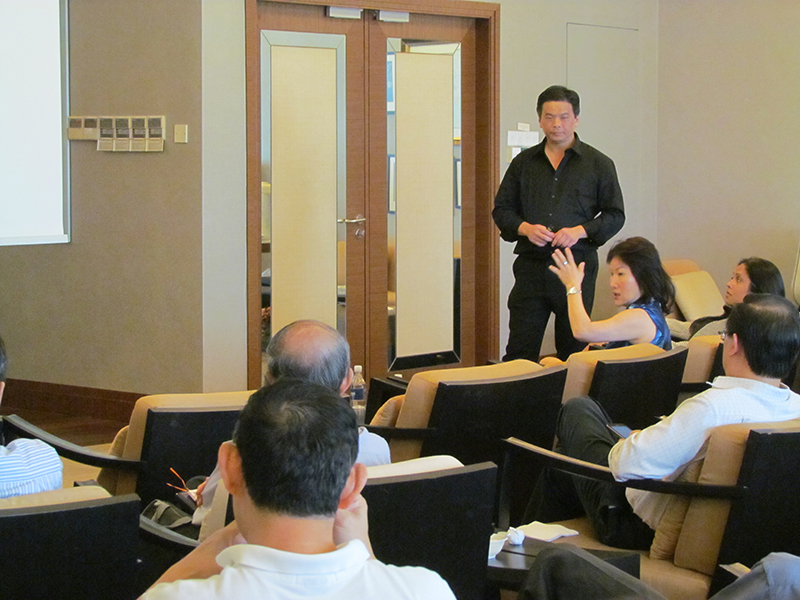
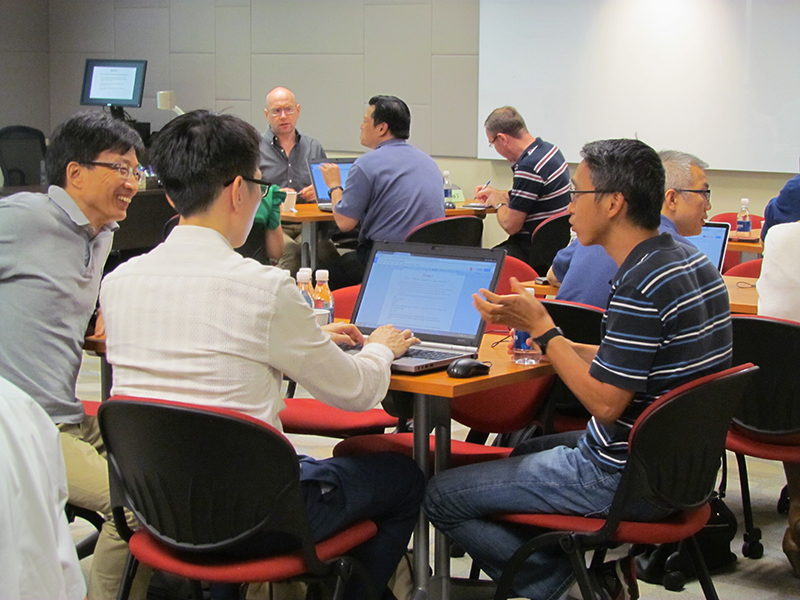
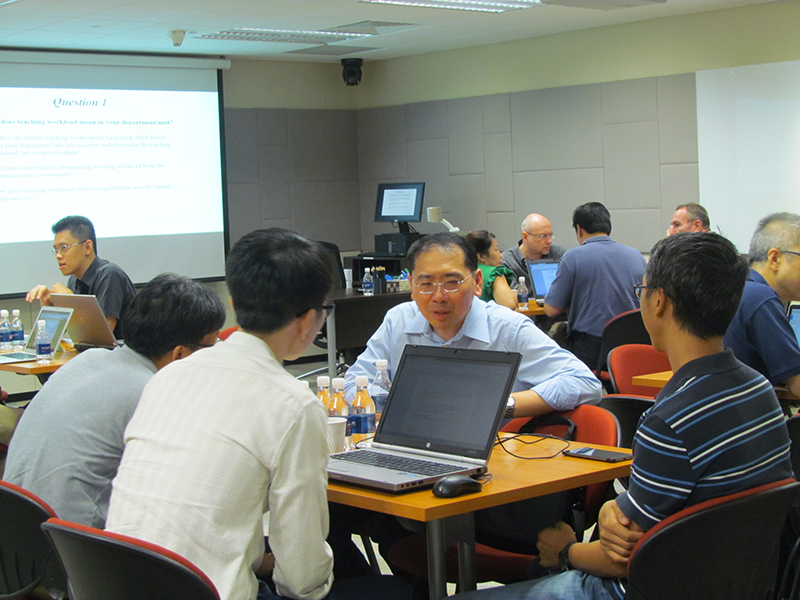
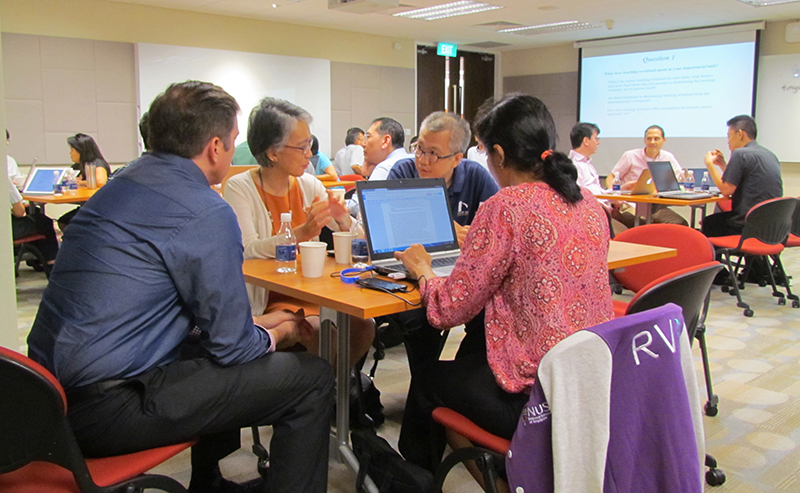
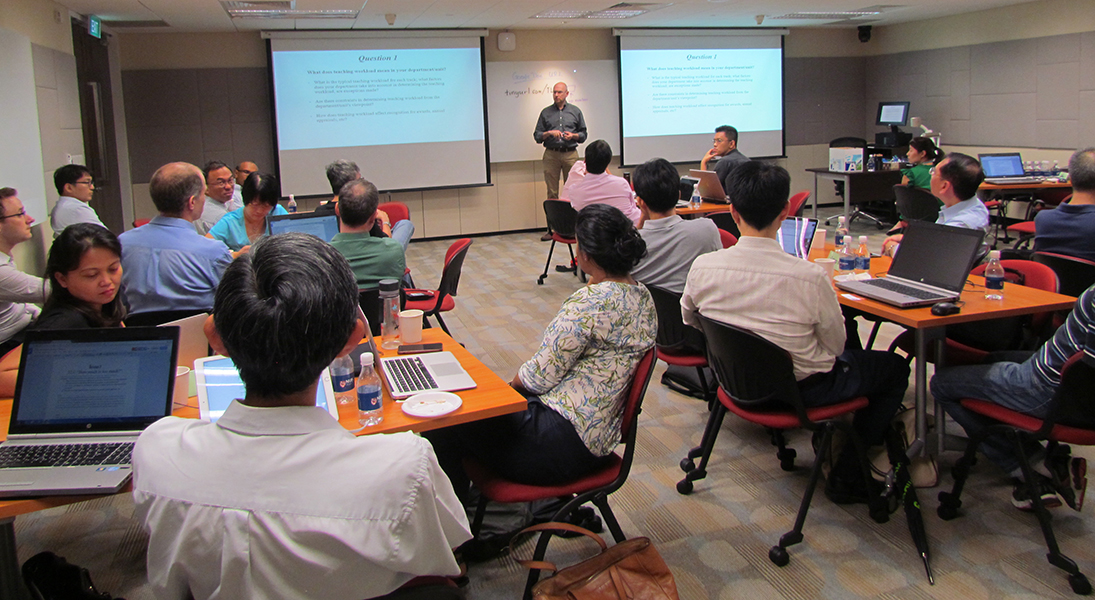
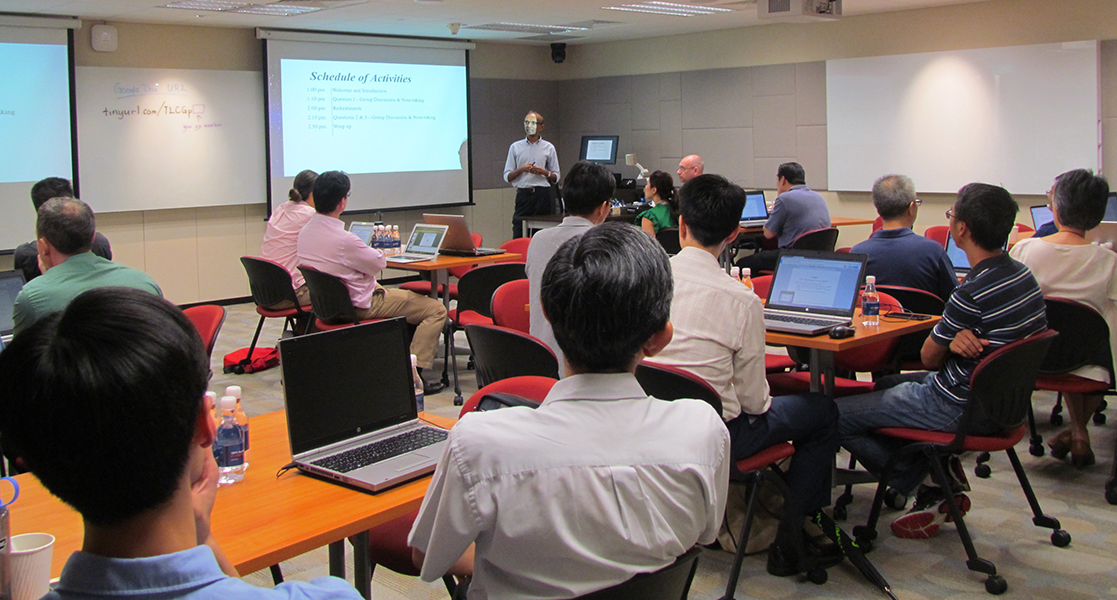
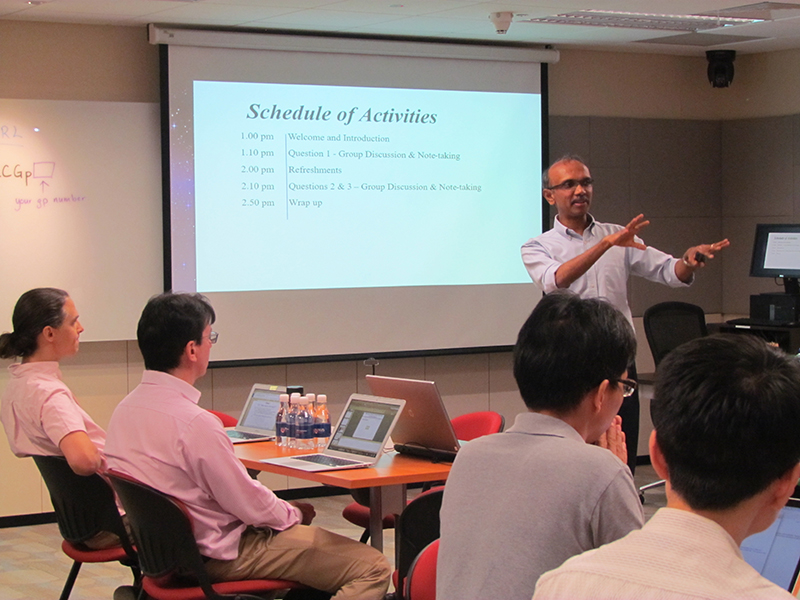
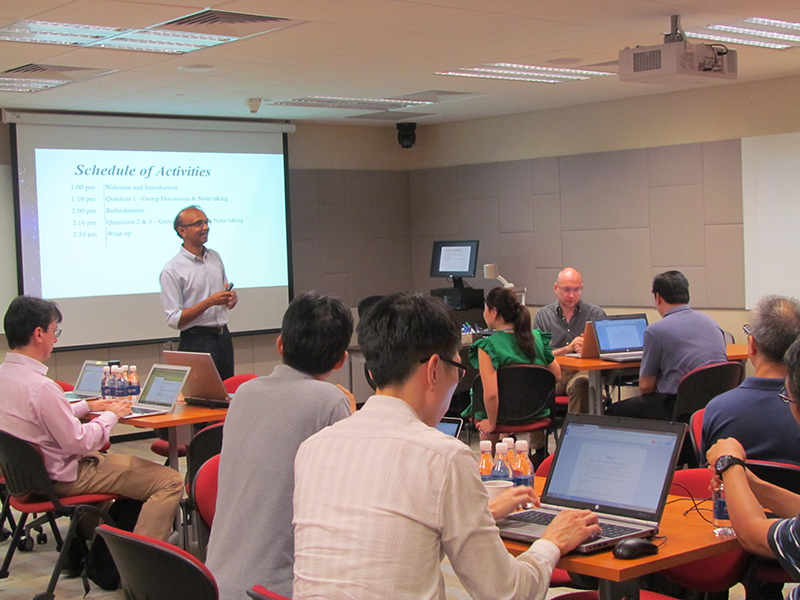
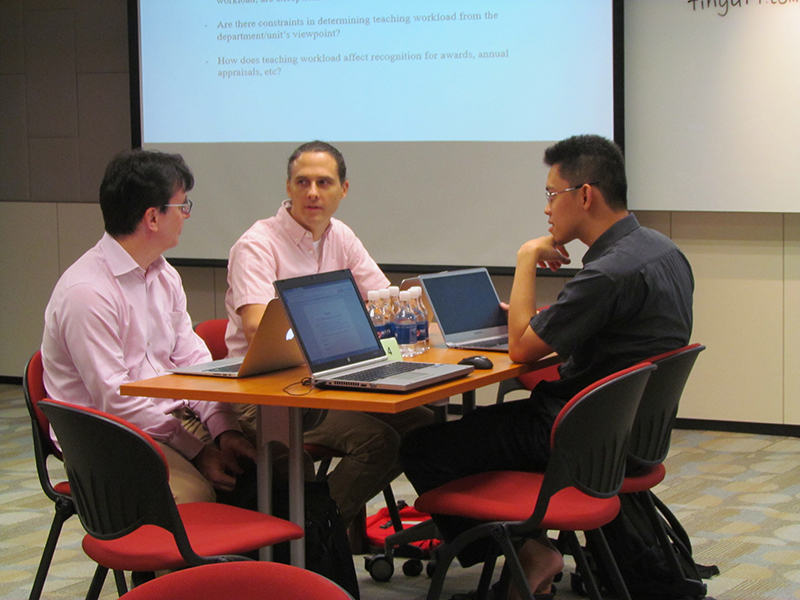
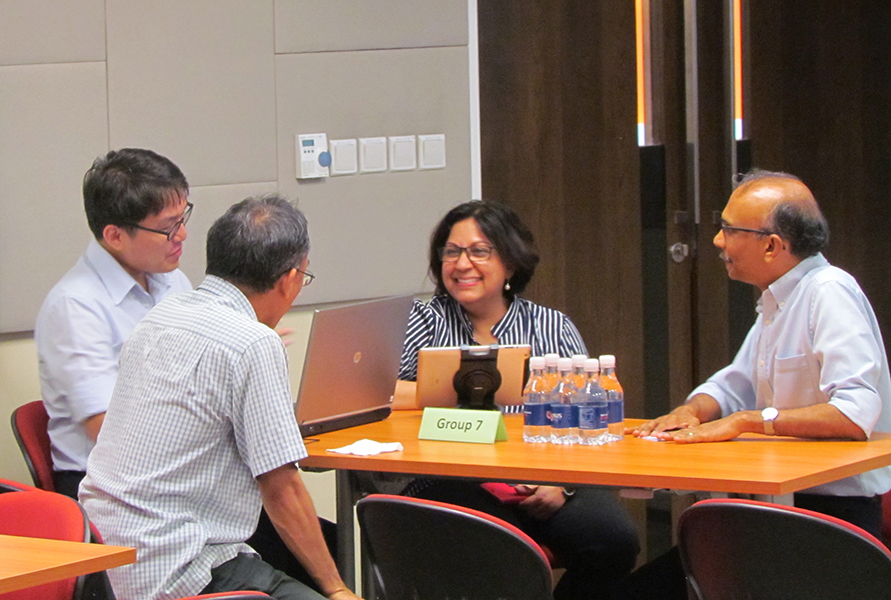
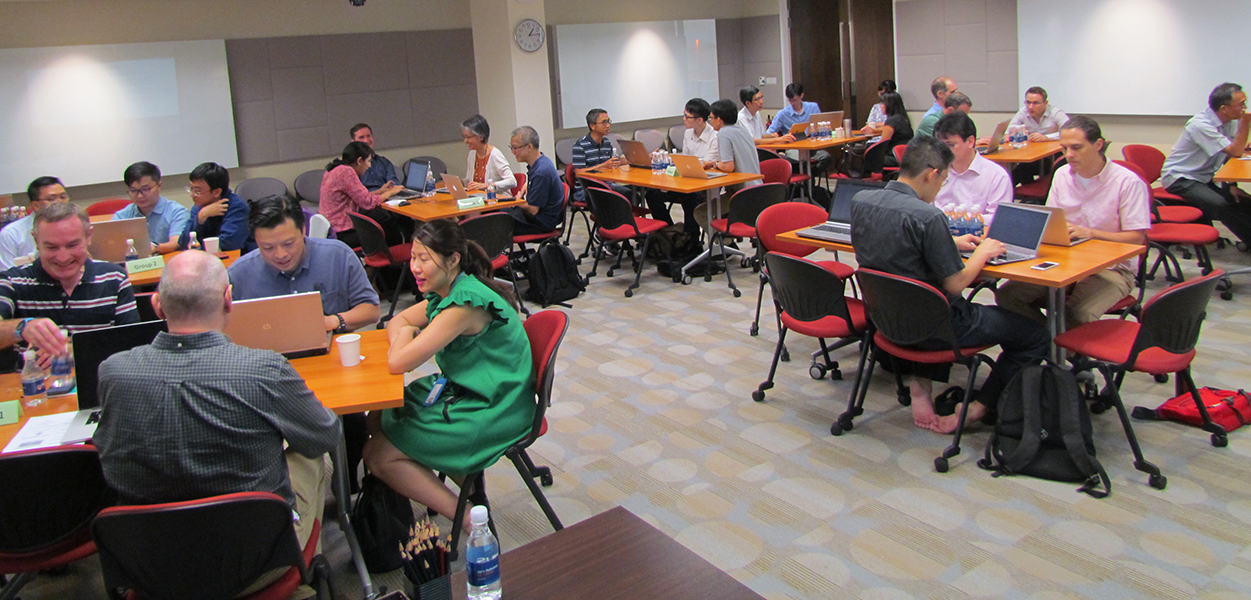
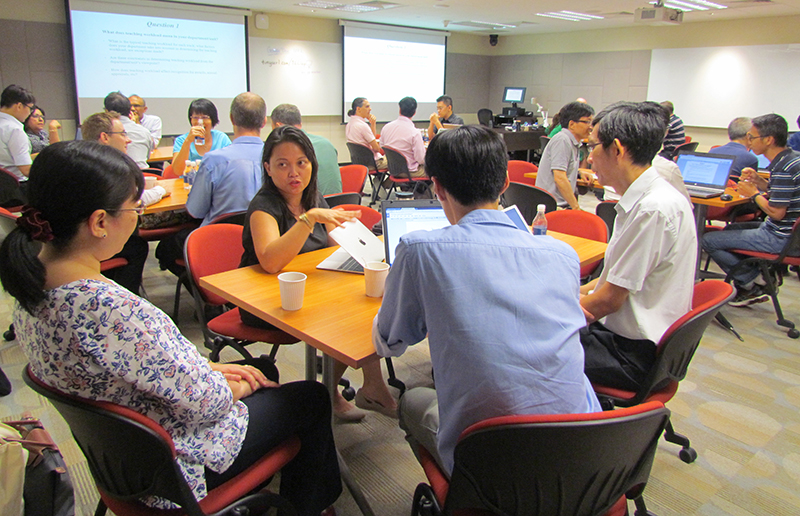
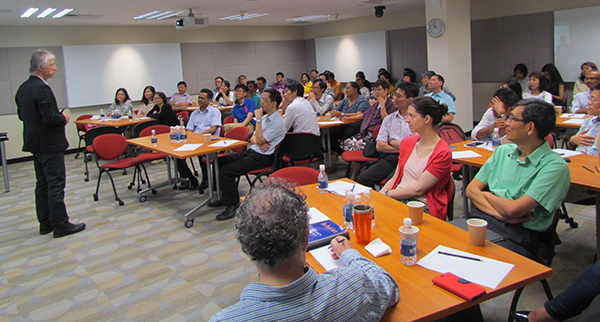
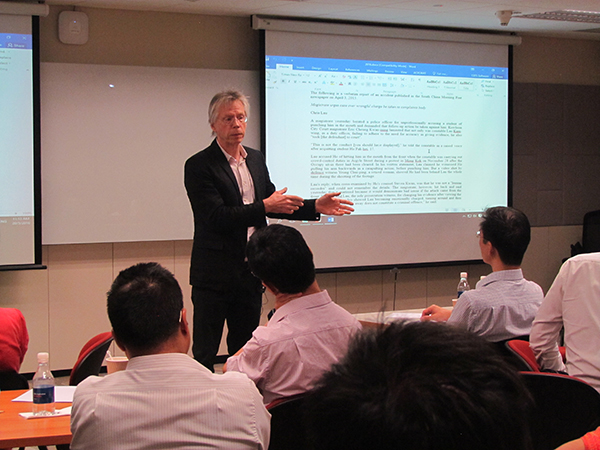
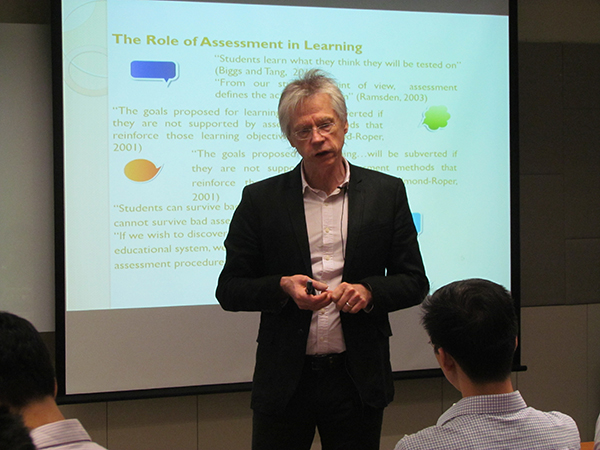
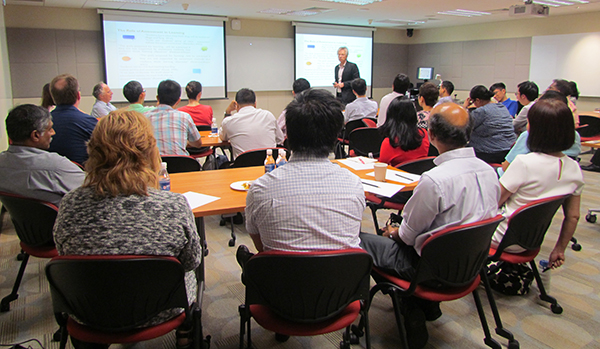
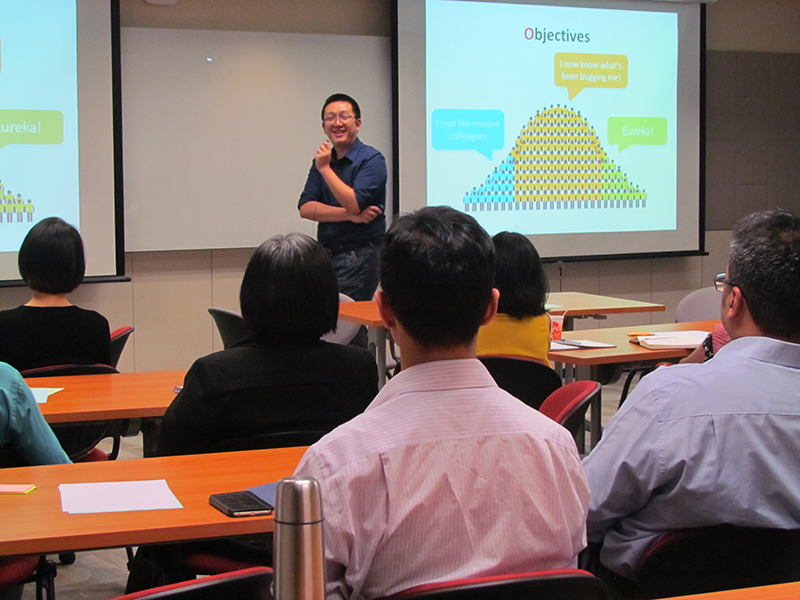
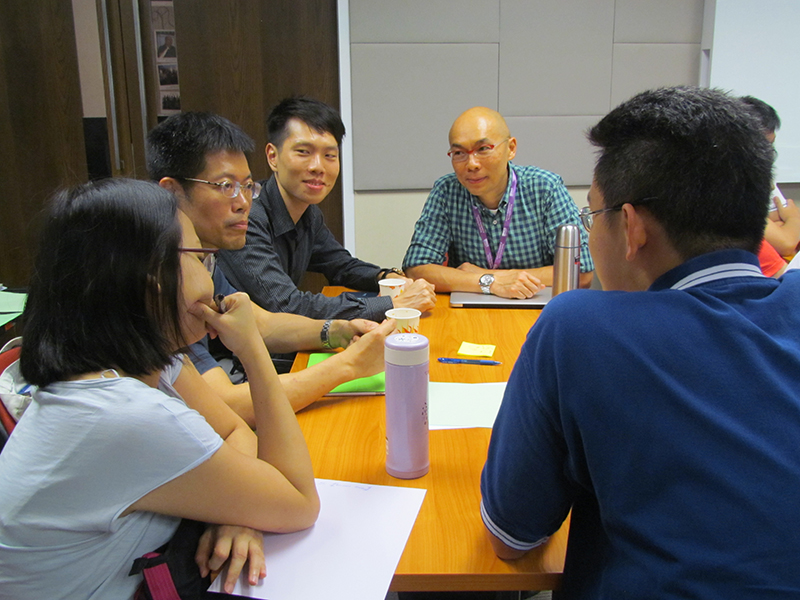
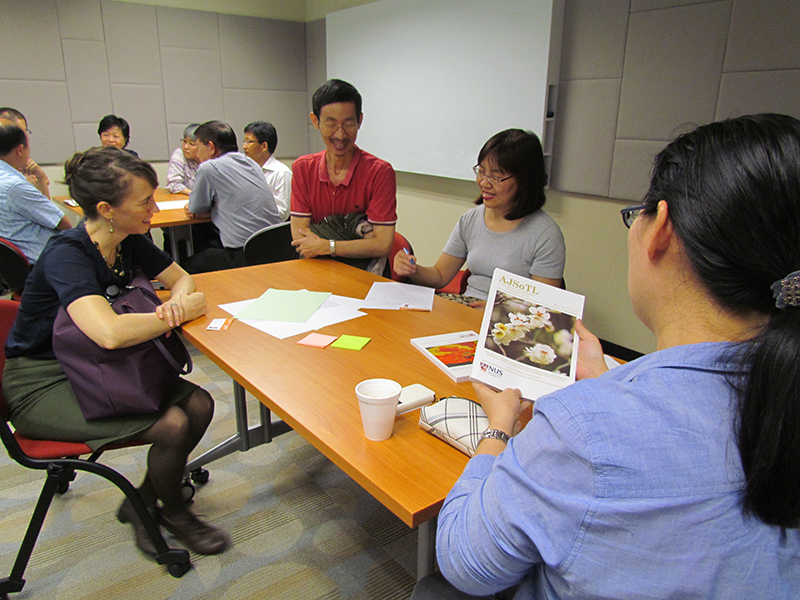
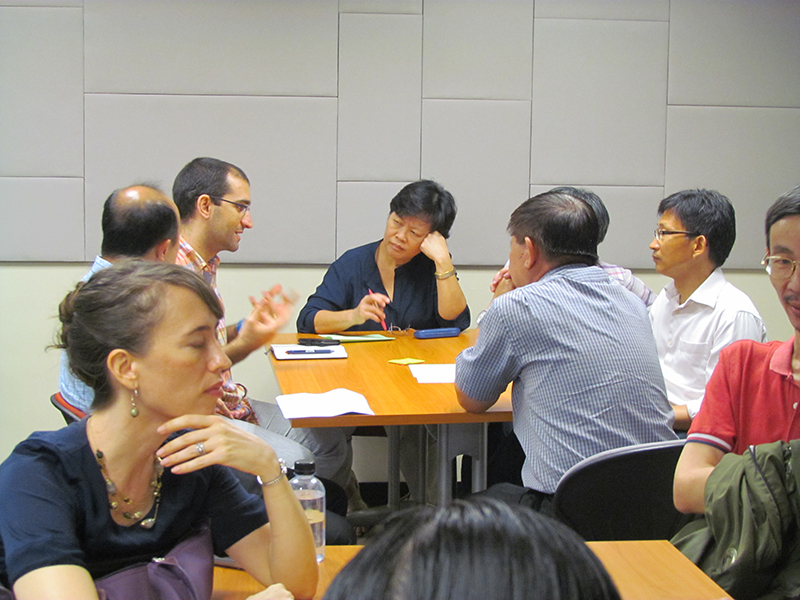
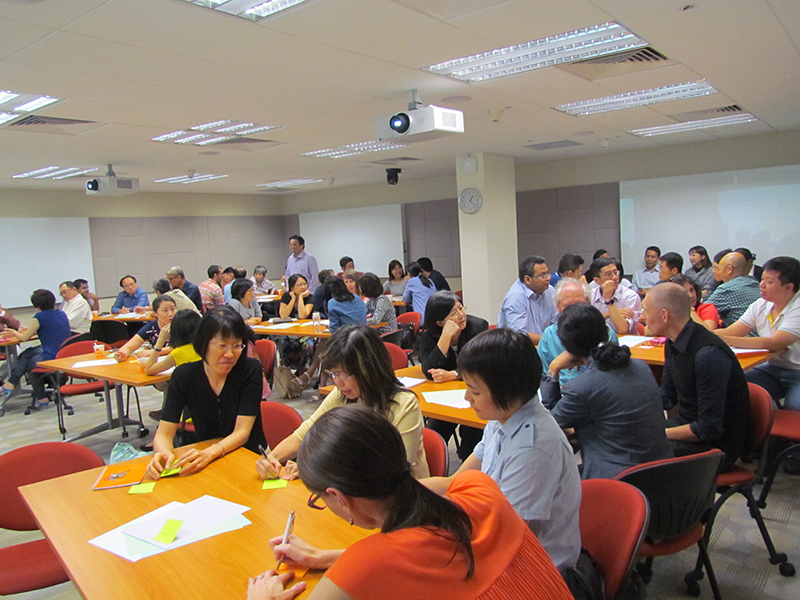
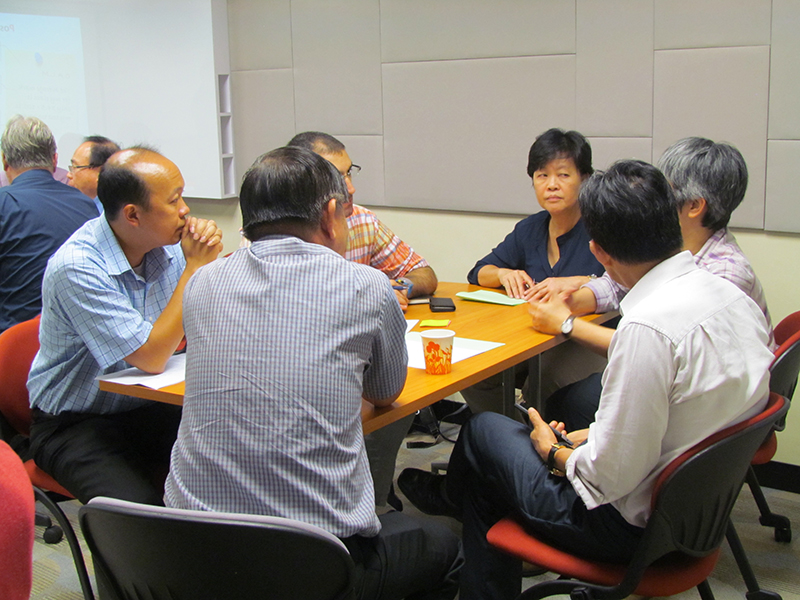
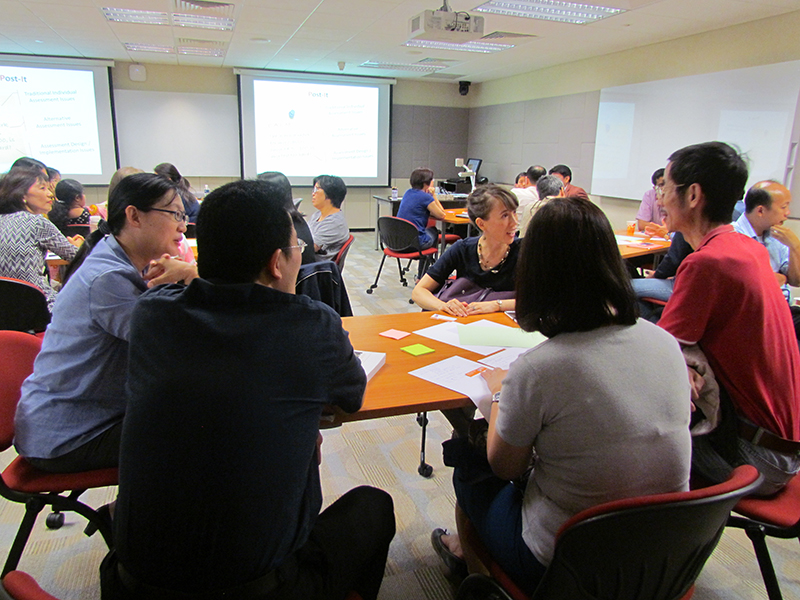
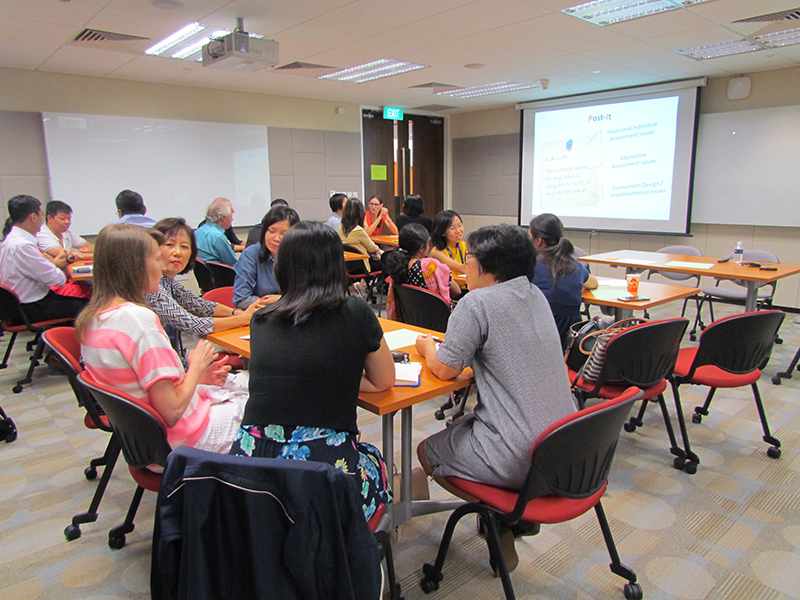
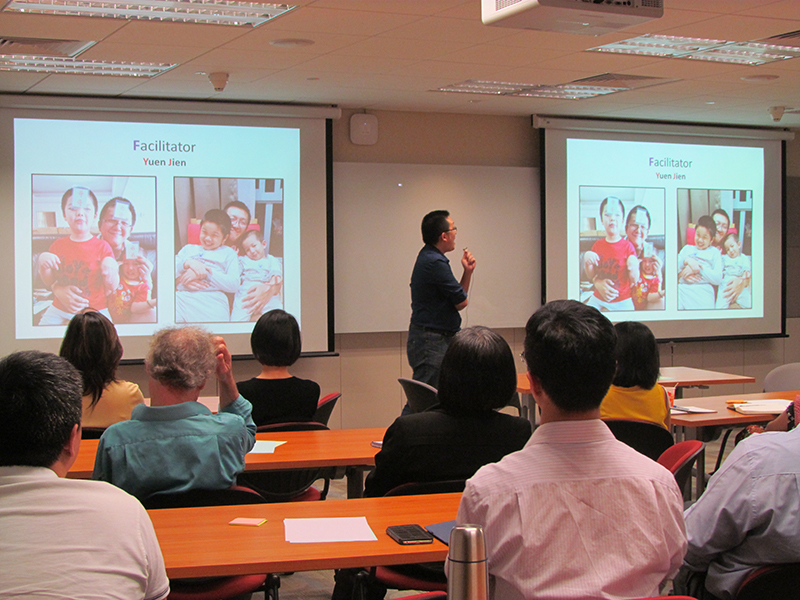
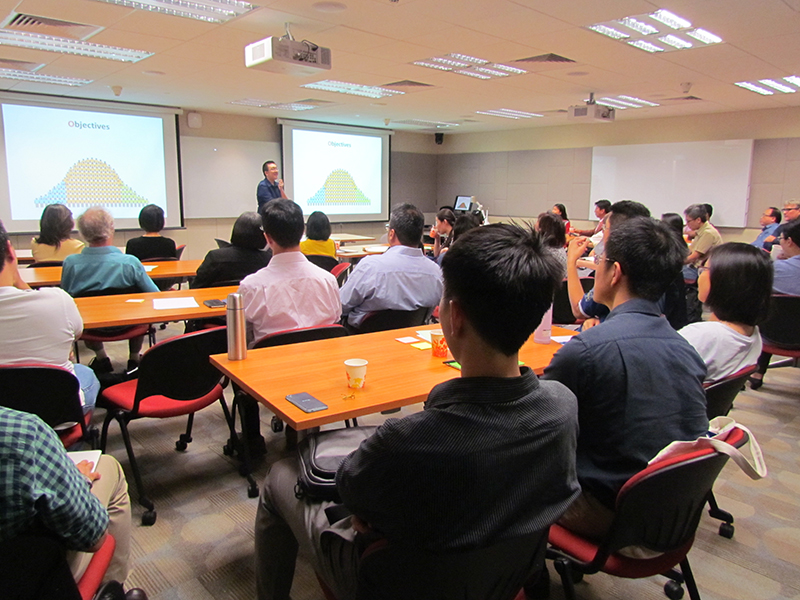
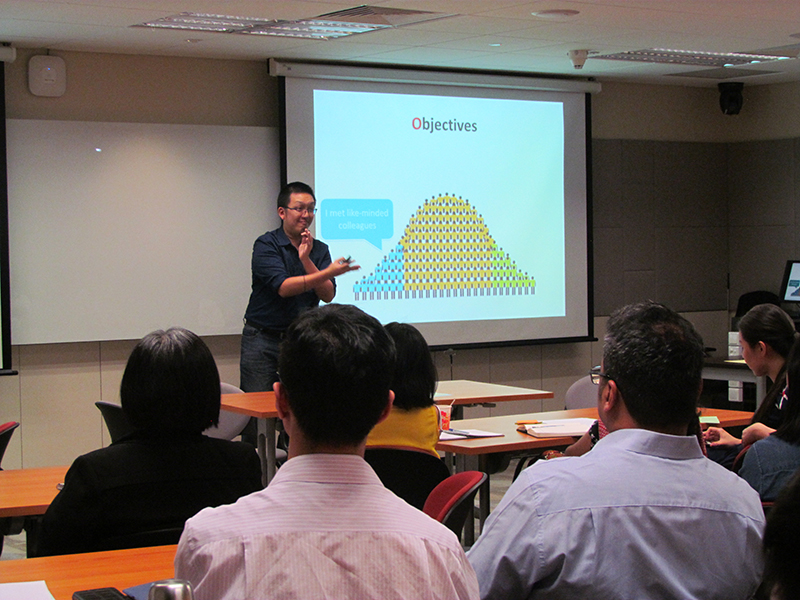
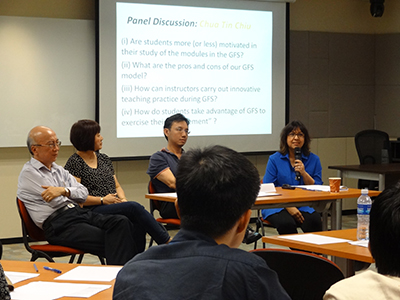
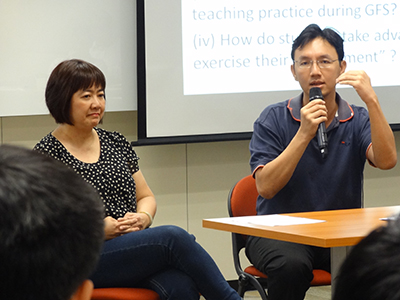
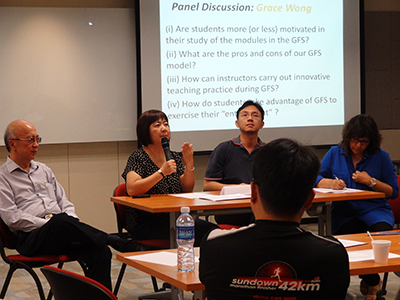
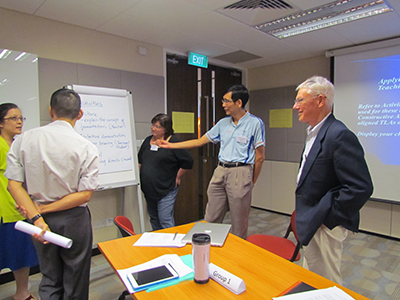
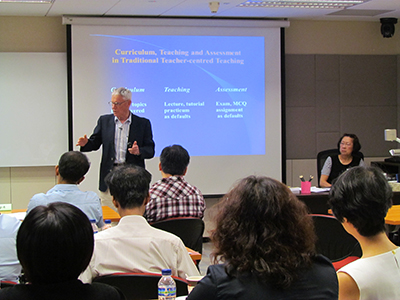
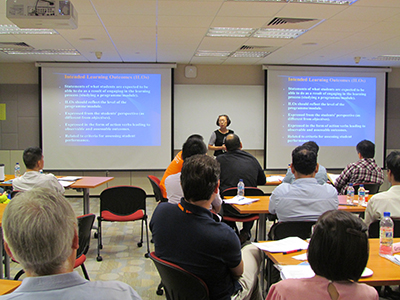
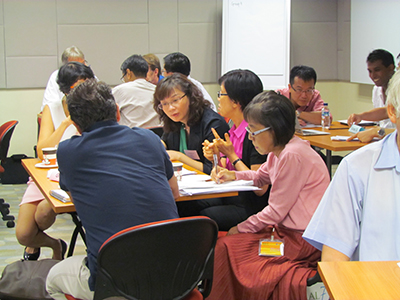
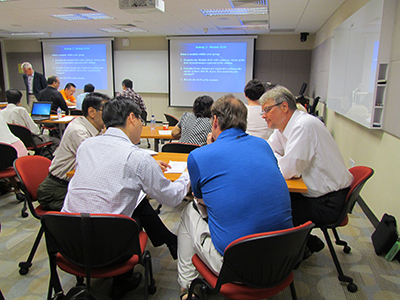
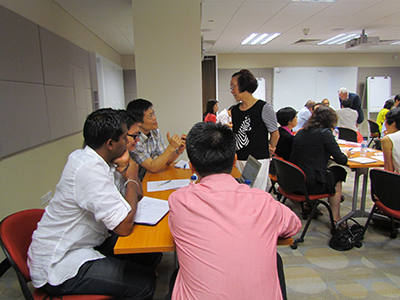
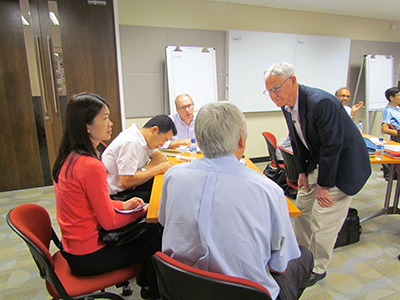
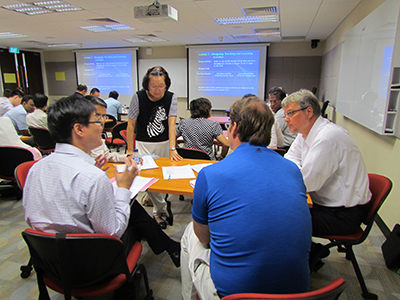
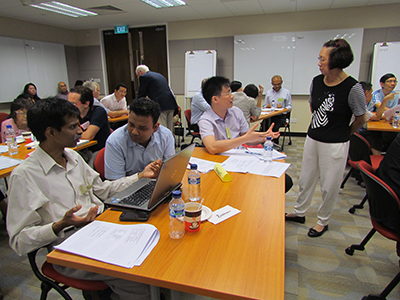
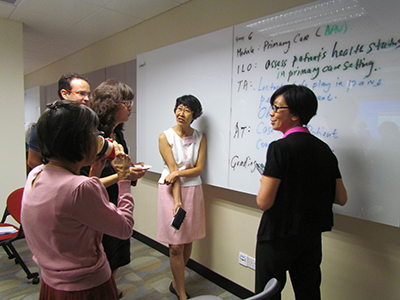
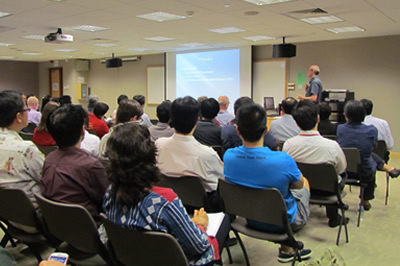
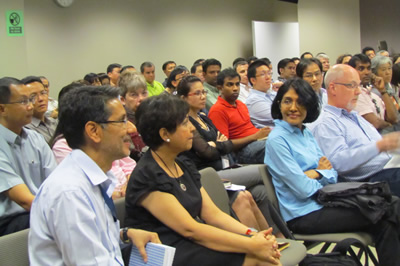
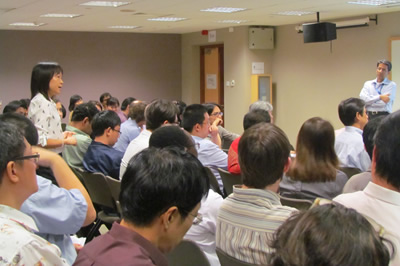
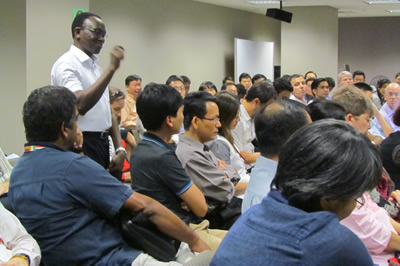
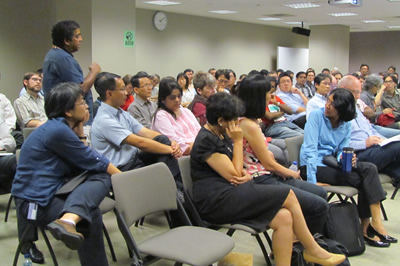
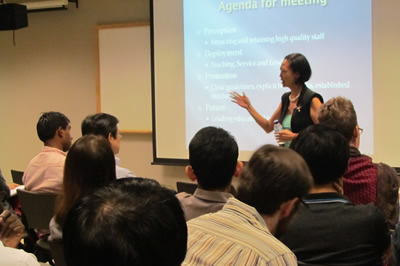
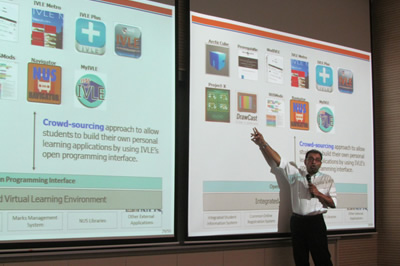
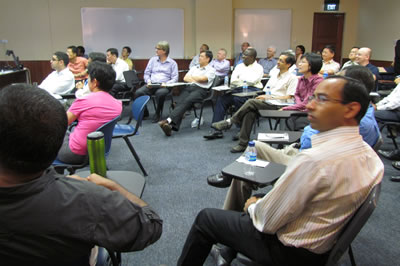
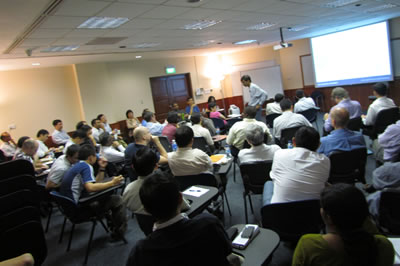
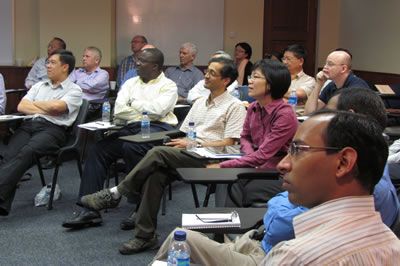
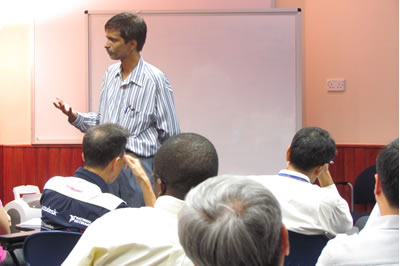
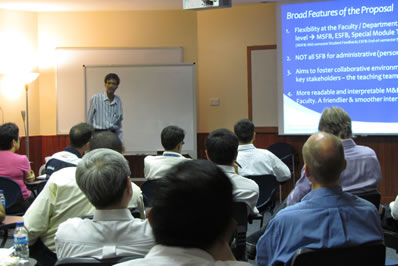
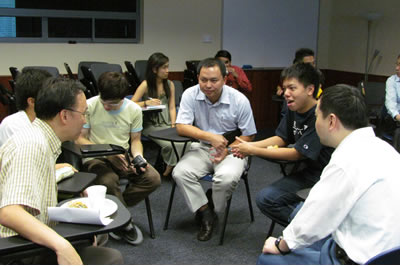
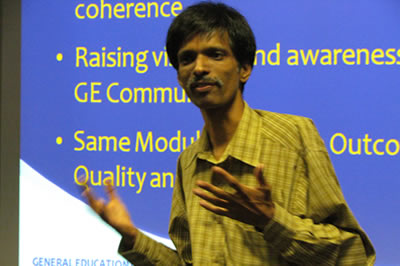
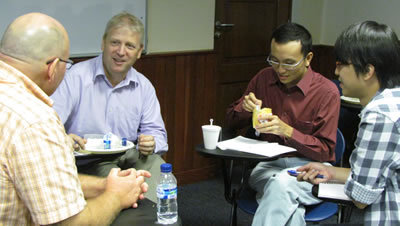
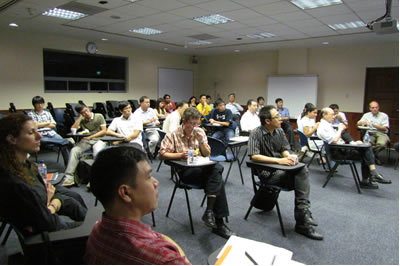
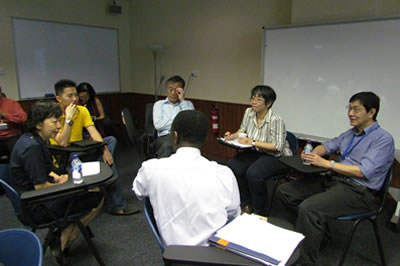
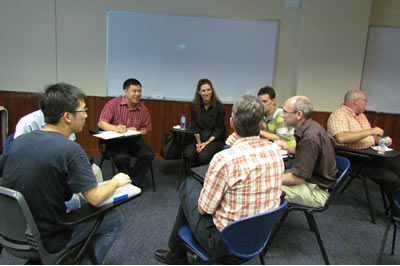
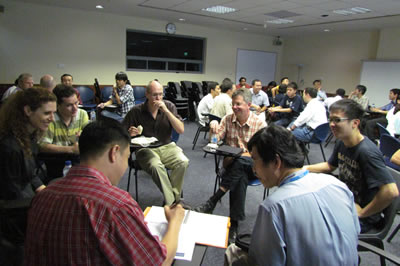
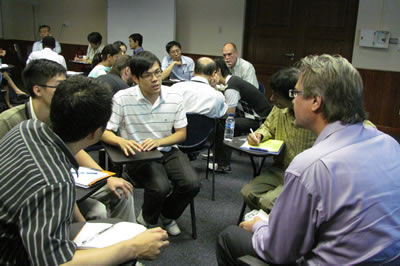
Conceptualised and facilitated by Fellows – Ryan Bettens, Olivier Lefebvre, Tan Wee Kek and Yeong Foong May, the TLC was held on 20 August 2019, and was well-attended by 54 faculty members (including 17 Fellows). A pre-discussion survey was used to find out participants’ perceptions about student learning and challenges with evidencing learning, and findings were shared.
The invited panelists were
Adrian Michael Lee (NUSTA Fellow, CDTL Deputy Director, OEA winner 2017) – Documenting Failure to reflect on and improve teaching with research-informed interventions.
Brenda Yuen (CELC faculty) – Rubric application and validation as a means to evidence student learning with the added benefit of consistent & clear articulation of ‘quality’ for tutors’ grading and students’ understanding of expectations. The rubrics also helped students engage in self-assessment and self-improvement.
Johan Geertsema (CDTL Director, OEA winner 2013) – CDTL Support to help colleagues evidence student learning. He clarified numerous issues/nuances pertaining to the evidencing of effective university teaching, including but not limited to measurements of student experience, peer evaluation, personal reflective narratives of growth, programme evaluation and more holistic approaches to student learning.
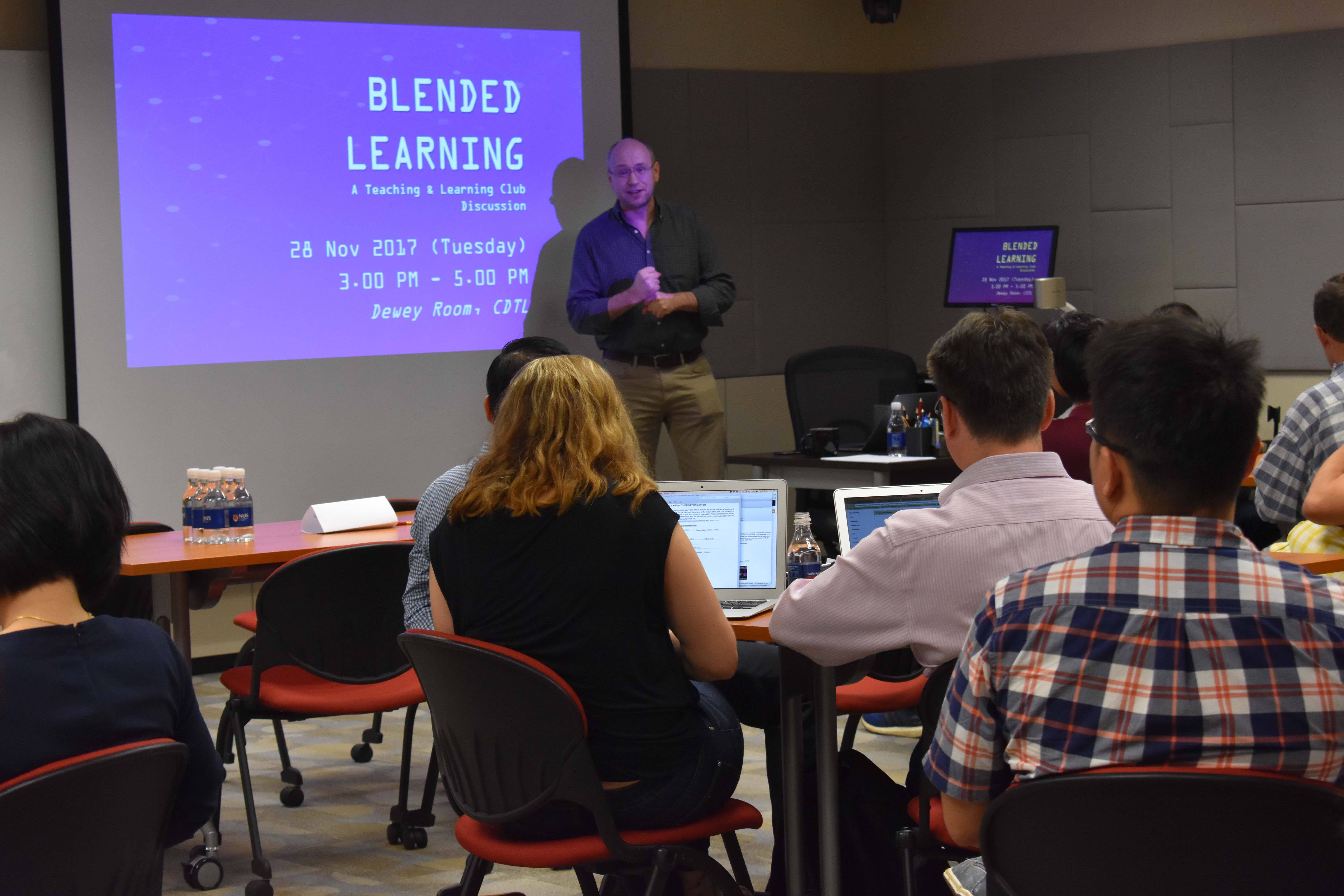
The TLC on Blended Learning was open to the Teaching Community and well-attended by diverse faculty, many of whom had done blended learning. It was led by Academy Fellows, Dr Adrian Lee and Prof Seah Kar Heng, and facilitated collaboratively by Fellows who have engaged in blended learning themselves.
Besides gaining a quick overview of how blended learning had been implemented by colleagues (e.g. models of blended learning, portion of course time spent online, resources used etc.), participants discussed both the benefits and challenges of using blended learning for different disciplines and for different student types.
In particular, participants shared that blended learning supported both pre-class content delivery and post-lesson follow-up additive learning activities, allowing more face-to-face class time to be used for collaborative work, on-site experiential learning of 3-D models, architecture, culture/heritage, and tutor-student interactions for direct clarification / explanations and skills development. Examples of blended learning used ranged from simple resources such as short videoclips and useful learning platforms to more resource-intensive formats such as games and VR experiences.
Although not all students were initially receptive to non-traditional lesson formats, a significant proportion became more accepting after gaining more positive learning experiences through blended learning. Participants noted that before students accepted the change in pedagogy/blended learning, some initial conversation to help students think about how they do learning was needed. In addition, it was important to carefully consider the quantification vs. teaching quality of teaching hours. The course structure (integrating blended learning with face-to-face lessons/lectures) also needed to be mindful of overall workload, term times and motivation techniques such as quick quizzes or peer work.
For the detailed collation of this TLC’s findings, interested faculty can request for the notes from the NUS Teaching Academy Office – cdtngcc@nus.edu.sg. The Academy will also continue to listen, so please do send feedback to us.
The fully-subscribed TLC session brought together NUS teaching faculty to critically examine the contextualization of generalisations about Millennial and Generation Z youth characteristics to our student body. Academy Fellows, Associate Professors Ashwin Khambadkone (FoE), Ho Han Kiat (Fos), Teo Chiang Juay (FoE) and Professor Wong Nyuk Hien led the discussions.
Besides articulating challenges faced, such as changes in students’ attention span, techno-literacy and multidimensional learning, participants candidly shared insightful observations about what students increasingly preferred as well as their changing reactions to teaching methods. The core values, principles and key outcomes of NUS’ educational philosophy were also considered, in addition to brain plasticity, the influence of emotions on learning and the value of some stress and intellectual discomfort.
Successful teaching strategies to engage students in sustained deep learning were shared by participants from diverse disciplinary backgrounds. There was also discussion about how Millennial and Generation Z students’ needs and issues could be addressed while upholding core principles that would help with their future employment in a VUCA working world.
The discussions were collated into a report on possible pedagogical takeaways. Faculty members interested in more detailed notes, please request from the Teaching Academy Office – cdtngcc@nus.edu.sg.
The Roundtable on Teaching Mentorship was convened to understand the state of teaching mentorship across NUS, to identify and share issues and best practices, and to explore possible synergies. Mentorship programme leaders from diverse faculties/ schools were invited to join in the sharing and discussions, led by Academy Fellows Professor Willie Tan (Building, SDE) and Dr Soo Yuen Jien (Computer Science, SoC).
Willie started by sharing the Academy Fellows’ initial consensus that there was wide variation in mentorship across our institution and that research-mentorship vs. teaching-mentorship were not always well-differentiated. Representatives from School of Computing, Saw Swee Hock School of Public Health, Duke-NUS Medical School (AM.EI), Centre for English Language Communication and Business School then kindly shared on teaching mentorship within their schools/departments. In particular, the following were discussed:
• Selection of Mentors
• Selection of Mentees
• Duration of Mentoring
• How it works
• Issues
• Suggestions
Several critical concerns were discussed and the Academy received confirmation that further resources and recommendations would be welcome. The Teaching Mentorship Sub-committee (comprised of a team of Academy Fellows) was hence formed after the Roundtable and the Subcommittee members have embarked on pulling together evidence-based recommendations on Teaching Mentorship for the NUS Teaching community.
Topic: Our Adjunct Faculty: Integral and Indispensable
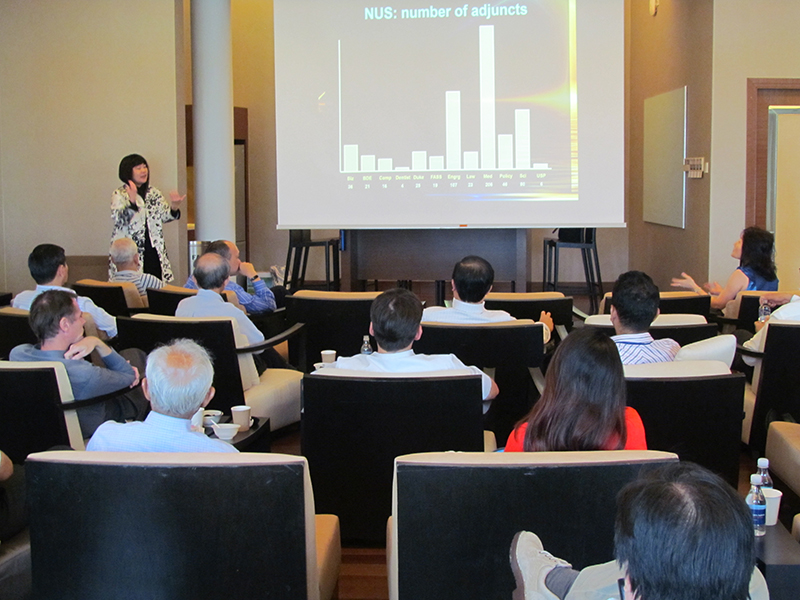
The Teaching and Learning Club discussion “Our Adjunct Faculty: Integral and Indispensable!” was mooted and chaired by Academy Fellows – Associate Prof Heng Cheng Suang and Dr Susan Ang. Held on 23rd March 2017, the TLC sought to ascertain how adjunct faculty presence could be ‘optimised’ to provide an enriching experience for all – departments, students and themselves. It was met with delight by many adjunct faculty who expressed appreciation for the opportunity to engage in such dialogue.
Before the TLC discussion, a preliminary survey was sent to almost all adjunct faculty from all NUS faculties/schools, and the results of the survey were compiled and shared with the participants in the TLC. As the Academy’s main function in this TLC was to serve as facilitator and conduit for adjunct faculty members’ perspectives and concerns, we have recorded all the major concerns raised – i) Teaching, ii) Research, iii) HR and iv) other general issues. However, as all non-teaching-related issues e.g. HR-related, have been conveyed to the relevant entities in NUS, this article will focus on the Teaching-related issues.
The pre-discussion online survey and the discussion itself made salient the following:
• To optimize utilization of adjunct faculty expertise, a significant minority felt that departments could give more consideration to modules/topics of interest suggested by adjunct faculty. In particular, those adjunct faculty who are also working professionals might be able to offer current perspectives on the basic knowledge or adequate foundation required of young graduates in their professions (i.e. they could contribute to curriculum design). There were also opportunities for the cross-fertilisation of departmental curricula or the development of cross-faculty curricula;
• To support adjunct faculty better in teaching, resources such as (i) dedicated mentors to help orientate them to departmental practices/guidelines; (ii) library resources and access know-how; (iii) designated work space/ computing/wifi access; (iv) funding; (v) updates on new pedagogies & teaching technologies; (vi) more varied feedback on their teaching, could be made more easily accessible.
• To boost adjunct faculty morale (and hence indirectly enhance quality of teaching), there could also be consideration of (i) more dedicated recognition such as teaching awards for adjunct faculty; (ii) more standardisation of adjunct-related practices across faculties, and (iii) more opportunities for adjuncts to engage in dialogue with adjunct faculty peers and university administration. In addition, as it was the adjunct faculty who are semi-retired or former members of the department that derived the most satisfaction and the strongest sense of social and professional integration from their adjunct arrangements, other adjunct faculty could likely benefit more from conscientious integration efforts by NUS and departments.
Following the TLC, the results of both the survey and discussion have been presented to the Teaching Academy, the Academy Executive Committee, Provost’s Office and other relevant entities in NUS. We appreciate the constructive inputs by all adjuncts who have participated and believe that appropriate follow-up actions will be taken to address concerns raised. We hope that through the sharing of concerns and best practices, this TLC will indeed bring about improvements to the optimization of adjunct faculty expertise and teaching
Authentic Learning and Task-Based Self-Directed Learning
Date: 20 May 2016
Time: 10.00 AM - 12.00 PM
Topic: Authentic Learning and Task-Based Self-Directed Learning
In the workshop, Professor Rick Glofcheski (Law, HKU) will share, by way of examples, two recent innovations in his teaching practice: authentic learning (and assessment); and task-based self-directed learning (and assessment). The presenter will identify the learning advantages produced by these practices, and will demonstrate how such practices can contribute in a meaningful way to the development of the habit of learning, setting students on course for life-long learning.
Assessment Matters: Common Challenges and Solutions
Assessment Matters: Common Challenges and Solutions
Date: 18 November 2015
Time: 1.00 PM - 3.00 PM
Venue: Dewey, CDTL
Topic: Assessment Matters: Common Challenges and Solutions
The TLC provides a platform for critical examination of ideas about Teaching and Learning. The fully-subscribed TLC event on Assessment at NUS engaged NUS educators from diverse faculties in candid discussions of concerns and best practices in Assessment. Prior to the session, all participants had responded to a survey on the issues relating to Assessment which they hoped to raise for discussion at the event. Dr Soo Yuen Jien – this session’s Facilitator, as well as A/P Heng Cheng Suang, designed the session accordingly.
Setting the tone for a collegial sharing session, Dr Soo gave a brief introduction on the TLC and invited colleagues to connect through group engagement on the following areas:
1. Assessment-related problems faced by faculty members.
2. Possible solutions to problems identified.
3. Systemic issues affecting assessment, and best assessment practices.
The following were identified by participants as the key areas of concern and strategies to address them were suggested:
Following a discussion of the above, the facilitator provided these tips:
1. Alignment of teaching and assessment with learning outcomes (Constructive Alignment, John Biggs).
2. The use of humour and trivia type questions to relieve the tense atmosphere of midterm tests.
3. The use of the spectrum of knowledge domains and higher order thinking skills to frame appropriate assessment questions.
The session concluded with an invitation to participants to continue discussions with the Teaching Academy Assessment Sub-Committee.
Faculty members interested in more detailed notes on the session, please request from the Teaching Academy Office – cdtvs@nus.edu.sg.
The meeting started with a brief introduction by the TLC Coordinator, Prof Farooq Shamsuzzaman and Dr Adrian Michael Lee, Chair of the Teaching Track (TT) subcommittee of the NUS Teaching Academy. He then introduced his subcommittee members and gave a short presentation on the objectives of the subcommittee and their future plans.
Key Objectives
Defining the role and future of Teaching Track
Refining and clarifying criteria for contract renewal and promotion
Recommending mechanism to support teaching scholarship, including pedagogical research
Future Plans
Collate feedback from this forum
Survey relevant groups (faculty members, teaching management and other institutions both local and international)
Analyse teaching data – gather information from student feedback report to assess the teaching performance of TT staff.
Make recommendations to PVO
Following the presentation, participants raised the following issues and concerns:
Fairness and consistency
Participants felt that there should be fairness and consistency in the following areas:
Granting of sabbatical leave
Provision of funding/start-up grants for research work
Remuneration package
Workload requirements and expectations
Job title change
There was a suggestion to change the title of Lecturer/Senior Lecturer to Assistant Professor (Teaching). It was opined that changing the designation will motivate the staff and change the perception of others about TT.
Promotional prospect/career progressions
Define what TT is and implement standardized or uniform guidelines across the university such as:
Having a fixed term appointment for TT staff – similar to primary, secondary and tertiary school appointments
Defining the criteria for the change from Assoc Professor (Teaching) to Assoc Professor (Tenure).
Recognition
There is a need to reflect the importance of practice in certain disciplines – staff under the Practice Track (e.g. Theatre Studies, Nursing, etc) should be given due recognition for their contribution to the practice component. Their roles/ participation in other areas and involvement in the industry should also be recognised.
TT staff should also be considered for tenured position based on excellence in teaching and contributions related to teaching.
Taking scholarship into consideration for TT staff to move from Senior Lecturer to Assoc Professor.
Research undertaken by Teaching Track staff should be measured and rewarded accordingly. The research should also not have to be pedagogical research, but include research within disciplinary domain.
Mentorship
TT staff who have made progression from lecturer to senior lecturer could perhaps act as a mentor to the junior TT staff.
A/Prof Chng Huang Hoon, (Assoc Provost, Undergraduate Education) concluded the session by informing participants that the Office of Provost will look into the issues raised at this forum and propose some recommendations for the University.
A/Prof Chng traced how the Teaching Track subcommittee was formed following discussions in CDTL – Luncheon meeting with faculty members from teaching track, tenure track and some members of the PVO. It was felt that the time was appropriate to take a close look at the Teaching Track, its current position and how it should evolve in the future.
She added that concerns raised during the meeting will also be communicated to Prof Lily Kong (Vice Provost, Academic Personnel) who is working on P&T issues.
Forum on Technology Enhanced Learning for Faculty & Students
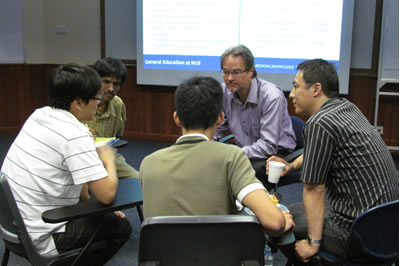
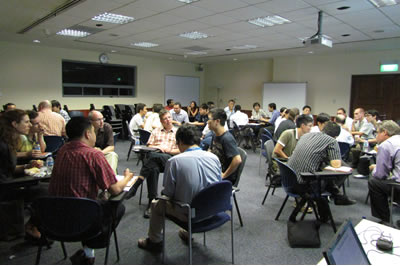
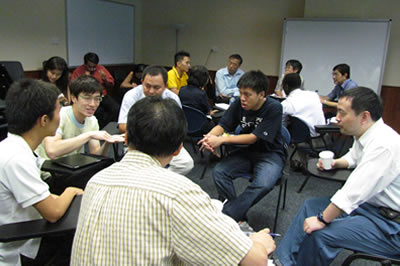
This was the first joint TLC meeting in which both students and faculty members were invited to participate. The meeting started with a brief introduction by the TLC Coordinators A/P Sow Chorng Haur and Dr Geertsema. A/P Laksh Samavedham, current Chair of the NUS GEC (General Education Committee) provided a short introduction to the evolution of the GE program at NUS, highlighted the aims of the General Education program, introduced members of the GE Steering Committee, and explained the rationale for the need to review and re-envision the GE component of the NUS education. The participants (6 students and 29 faculty members) were then divided into small groups comprising both faculty members and students, and each group was tasked to discuss and reflect on assigned questions. After a 20 minute “buzz” within the groups, one representative from each group was then invited to present a summary of their conversation; further comments on the issue were solicited from the rest of the attendees. In addition to the face-to-face TLC meeting, we also received a number of comments and suggestions from colleagues and students via email. We summarize the substance of these discussions, comments, and suggestions below.
Question 1
For Staff: Has the teaching of GE been a positive or negative experience for you?
For Students: Have GE modules helped to cultivate your critical thinking skills? What kind of experiences have you gotten from the GE modules you have taken so far?
The majority of staff members expressed the view that teaching GE has been a positive experience for them. Many felt the learning experience to be enriching.
Factors contributing to the positive experience include:
Large class sizes and the lack of quality teaching assistant support were pointed out as negative aspects of the GE experience.
Including new materials into the module every year is exciting.
It is enriching to include other issues/topics into the general module.
Seeing students learn from each other, especially during the tutorial presentations, is akin to inter-professional education. The coming together of students from e.g. Business School, Arts and Social Sciences, Engineering, and Nursing enables the exchange of ideas from different perspectives.
Getting to decide what to teach is in itself an opportunity that faculty members cherish.
The mixed profile of students is seen as a plus point.
Students enjoy learning a non-home module.
Take away messages for GEC:
Providing choice for faculty members to teach in their area of passion is very likely to get their buy-in and enthusiasm in offering high-quality GEMs. The key for management is to ensure that the subjects chosen in the modules and the ways in which students are taught, assessed and provided opportunities for improvement are coherent with the broad subject themes and teaching methodologies envisaged under the new GE plan.
The GE modules must involve group-work activities (with carefully formed teams) as these have the potential to widen students’ perspectives and help them transit into an increasingly multidisciplinary, multicultural work environment.
There must be a serious attempt to reduce class sizes to more acceptable levels in GEMs. Support in the form of quality teaching assistants must be provided for purposes such as grading CAs, preparing course material etc. under the active mentorship of the faculty member offering the GEM.
It may not be a bad idea to hire top quality senior undergraduate students as teaching assistants. In addition to our graduate TAs, this talent pool may be tapped into.
Interesting use of ICT to create interdisciplinary student learning communities should be attempted. Some faculty members may be doing it and such practices must become more pervasive in GE modules.
Question 2
For Staff: In your experience, would you say General Education has empowered NUS students to doubt and question, to evaluate critically what is considered to be knowledge, and to discover and construct knowledge on their own?
For Students: Have you found the abilities developed through the GE program useful in your other modules?
Students indicated that the GE modules have made them question and re-evaluate what they see around them – they link what they do in classes and tutorials to common everyday things. For instance, some have become more aware of design innovations and have even managed to design some useful gadgets to help in their homes.
Students also felt that GE is an excellent gateway for students from different disciplines to bravely venture into and learn new areas. It would be nice to have a GE club that would also include faculty members so that we can embark on life-long learning.
GE in NUS has well-designed academic programs, a clear mission, high-quality faculty, committed students, and adequate resources.
Might it be better to have students at the same level of study in GE modules? In some classes there are Year 1 students with students from other Schools who were either at the graduating year or from Year 3. This creates a vast heterogeneity in terms of reasoning abilities, content knowledge and maturity level of students.
Take away messages for GEC:
It may be good to consider having most of the GE modules or ULR modules as part of a high-impact first-year experience for all students. If students are required to do 5 ULR modules, we may prescribe that 3 of them must be completed by the first year (perhaps even in the first semester) and the remaining two be done later. The above would ensure that the playing field is “even” in at least about 60% of GE modules. The composition of the cohort doing GE modules would be homogeneous. There would be less of a tendency for the GE modules to be relegated to the major or core subjects as the students would be doing GE modules in a concentrated fashion. The suggestion for doing only 3 of the 5 modules in the first semester/year is to provide flexibility for students with the remaining 2 modules. Also, students must experience some heterogeneity which they will have to face when they enter the workforce.
The idea of forming a GE community (or forum) for faculty members teaching GE modules and using that to interface with students and amongst themselves is a very important one. It is not enough to have a GEC to oversee GE at NUS; rather, GE must become participatory, self-regulating and an evolutionary enterprise. This can happen by drawing in wider participation and having dialogues between GE faculty and students. This TLC event itself was a good start in that direction. The GE community on campus must physically meet once a year for a campus-based summit on General Education and how it may be continuously improved.
Question 3
For Staff: Should students be required to take more GE modules–or fewer?
For Students: Do you think students should take more GE modules–or fewer?
There were mixed opinions on this question.
Although students did say that they have enjoyed and learnt something useful from GE modules, there was a feeling that there is really not much space in the curriculum for more GE modules (without increasing the overall MCs). There was a suggestion to conduct some surveys on the usefulness and effectiveness of GEMs before this question can be answered.
Some responses received from participants include:
The number of modules can be one or two fewer, but definitely not more.
Each undergraduate student should take no fewer than two but no more than 3 GE modules.
There could be more GEMs but not at the expense of their own major programme, especially if it leads to a professional qualification. The bottom line is graduates must be competent and safe practitioners when they enter the workforce. If the GE module can enhance their professional development, then it is fine
Can’t comment, depends on the discipline.
Students like to take more GE but there are time constraints with regard to graduation
Students need more than 2 GEMs.
Take away messages for GEC:
The GE is supposed to be a direct reflection of any University’s teaching philosophy and the kind of graduates it wants to create. Thus, there is a need to assess the impact of GE on the NUS student going beyond the student feedback that we collect for all NUS modules. We can do this by having some questions in the NUS graduate exit survey, alumni/employers survey that specifically elicit their responses on their GE experience. For GE modules, we could consider having the “2 flexi” questions in the SFB form to address the GE outcomes we hope to have. The dialogues through the TLC or the GE Forum can help us gain information on the “health” of the GE programme at NUS.
The actual number of GE modules (or the size of the ULR) will be governed by external forces as well – the external environment is in an active state of flux, the expectations of the workplace is changing and there is an ever increasing responsibility on part of the University to provide the best balance between breadth and depth, between generic versus discipline-specific skills and abilities etc. This involves a certain amount of prediction and making informed choices – best done with the participation of the employers and alumni.
Question 4
For Staff: What are the drawbacks/bottlenecks of the existing system, and how can some of the issues be resolved?
For Students: What have been your challenges in accessing and taking GE modules?
It is challenging to teach due to the mixed profile of students.
There is a lack of incentives to offer more GE modules. There used to be some incentive scheme to those teaching GEM/SS Modules, but we have not heard of it in recent years. Even that may not be a large enough carrot for some faculty to spend much of their time preparing for a GE module.
A class size of two to four hundred students presents difficulties especially when answering email near exams — there is a need for more TA support, better LT design like installing a clicker at every seat, and it would be good to reduce class sizes. It would be better if we are able to reduce the overcrowding in some of the classes so that more attention can be paid to individual students. Also, introduction of new modules in various interdisciplinary streams should be useful for the students in the fast-changing world scenario.
Some students are slightly withdrawn in the class and want to just finish this module rather than taking it out of passion.
There is a need to find out the motivation of students for taking up a specific GE module. Some students indicated that they were interested because they perceived the GE would help them in their future career development, while some said it was the only module that did not clash with their time-table.
GE requires students to go outside their comfort zone, and grading can create stress: students may choose to not really step out into “unknown” territory.
Because GE is graded, students focus on exams and who sets the exams — should GE be graded? However, the problem with S/U is that students may go for the base line.
Of 6 modules per semester, with one as GE, students will focus on core modules rather than on GE, and so critical thinking skills etc. are lost.
GE gets diluted by cross listing; these modules should be small if they are to promote critical thinking. Modules should be preserved as GE and not cross listed.
Oversubscription of popular modules is a problem as this makes it difficult for other students to access some modules. Sometimes there is a non-alignment of the course description and what was actually taught (“the product is different from what is advertised”). Grading can be unfair to students coming from “outside” faculties — some students have better background than others etc.
The emphasis on the results needs to be reduced, so that students are allowed to take GE modules which they enjoy.
Seniors have more CORS points and so can get the GE of their choice. Students don’t enjoy GEMs in their senior year because they are focused on their majors. If a GE class is too big students do not get value added.
Take away messages for GEC:
The discussions clearly indicate that grades are a serious issue for students (no surprises here) and not all students will do the modules only for the joy of learning. Factors such as timetabling, easy modules (close to major area of study, or less work in order to get the grade that one wants compared to another GE module) all hold sway. The S/U option may be a good handle for students to step out of their comfort zones without the fear of their grades affecting their CAP; the counterforce is that even if students go out of their comfort zone, they may just do the minimum required to get the S grade. This may be alright but would the S/U option for GE modules draw students out of their comfort zones? Would mandating that the GE modules (or ULR modules) be done outside of the students’ home faculty help? As of now, only one GE module needs to be done from outside the home faculty.
The other idea is to completely neutralize “comfort zones” in the GE space. All modules must offer the same kind of learning experiences for students – this means that we could adopt a numbering-up approach rather than a scaling-up approach. For this, the class sizes have to be uniform (and “small” enough) and the faculty should adopt the core principles of the GE programme in terms of teaching/learning methods, facilitating quality student interactions (among themselves, with the subject matter, and with the faculty), assessment modes etc. How this numbering-up can be achieved with the resource constraints we need to deal with is a fertile area to try out some innovations, and different colleagues shared different experiences and experiments in this regard. Students must be guided away from viewing GE as a means of minimizing risk, and towards seeing it as an opportunity for maximizing their educational experience at NUS.
The idea of giving CORS points to students who fill out the end of the student feedback is a pragmatic one. However, has anyone paid attention to some of the abuses (or unintended consequences) of CORS points based bidding? Is there a negative aspect to the CORS points – GE enrollment link? If it is a significantly negative link, some rethinking on this aspect may be in order.
Question 5
For Staff: What is missing from / what can be some good additions to the GE program?
For Students: What is missing from / could be some good additions to the GE program?
Students to undertake more practical assignments/coursework (maybe make UROPS a compulsory module for all undergraduates) that can adequately prepare them for future jobs, especially in the private sector.
Percentage of CA can be increased, mainly project/participation based, and the exam component may be reduced.
Unable to answer this question as it depends on the aims and objectives of the specific GE module.
More GE modules needed, higher CA component.
There should be more GE modules that devote attention to the history and philosophy of particular disciplines.
Find a way of not having GE affect the student’s cap, but allow the credits to meet degree requirements.
The idea on the S/U option being open for GE modules regardless of whether it is within the student’s faculty (for example, currently science students are not allowed to S/U any modules offered by faculty of science, including GE modules), would allow students to explore other areas of studies without being afraid of the grades.
Cross listed modules should still remain open to everyone, especially since they teach multi-disciplinary fields that will definitely not be taught within the core modules.
Grading discourages risk taking –S/U takes care of the fear factor, emphasizing more discussion and group work, and allows for the use of more open-ended questions which have no definite answers.
Take away messages for GEC:
Students appear to prefer GE modules conducted in small groups, using discussion type classes (as opposed to traditional lecturing) and dealing with multi-/inter- disciplinary content.
One strand of the discussion on this question centred around the need to have more GE modules regarding the philosophy and history of different subject areas – for example, the philosophy and history of science. Seminar-type modules were also seen to be positive additions. Cross-listed modules were seen as diluting the GE programme and there may be a case for delinking the GE modules from the faculties/departments. The committee should work at strengthening the programmatic coherence of GE so that it has greater intellectual coherence. It should also be noted that all modules, not just those in the GE programme but also core modules, should encourage critical thinking.
The other strand of the discussion related to the kinds of learning/assessment activities one might want to see in the GE modules. Students expressed the view that they would not like to see the GE modules having final exams that are heavy in content. They preferred group work, the use of multiple modes of assessment and use of open-ended questions and project work. As we all know, it is not enough to change the content and methods of engagement in classroom and outside – as part of the overall package, innovations in assessment and grading procedures should also be brought about. All this may need to involve dedicated human resources.
Question 6
For Staff: Should GE modules have compulsory final end-of-semester exams?
For Students: Should GE modules have compulsory final end-of-semester exams?
We had a mixed response to this question.
Some favour the removal of final exam and propose to add more CAs.
However, a faculty member pointed out that this could not work for a design module. It might, though, be possible if the module had been on other subject matter.
Yes, the practice of giving exams should be continued, as this reminds students to learn and study throughout the year.
Yes. There must be an exam. Otherwise nothing is taken seriously. However, the exam component weightage may be reduced.
It depends on the subject area. If it is to encourage team work, critical thinking and shared learning, then project and group presentation would suffice. If the GE requires the students to reach a level of understanding and critical knowledge and skills, then exams are required.
Depends on the module.
Take away messages for GEC:
It appears that a final exam may be important after all – even many students see it as a necessity to bring all the learning together. The way out could be to have a high percentage of CA and to have a 30% or so final exam component that focuses not on content but higher order cognitive skills such as analysis, evaluation, synthesis etc.